

Fortune News | Jan 23,2021



Nov 19 , 2022
By Robel Mulat
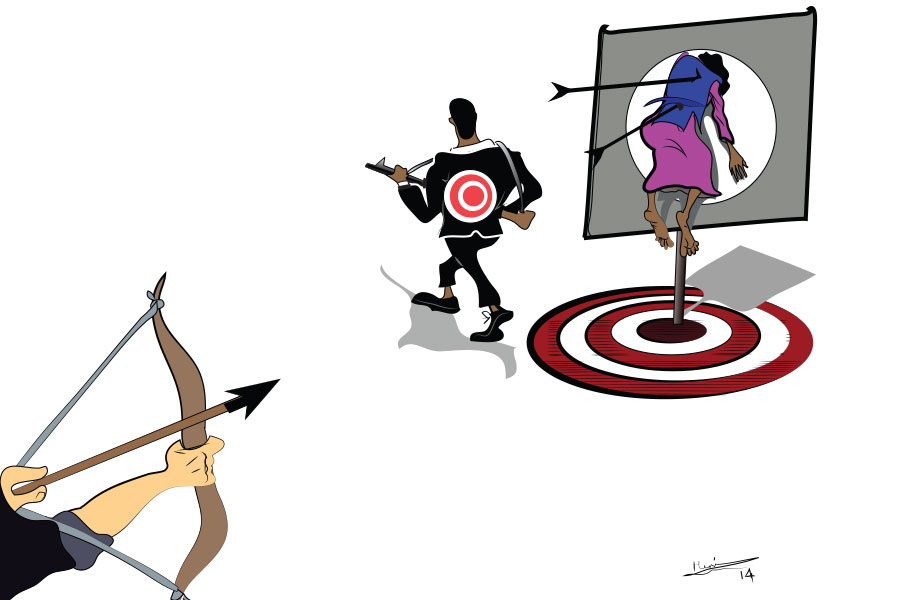
The delisting of Ethiopia from America's preferential trade regime, a.k.a the African Growth and Opportunity Act (AGOA), undoubtedly sent shockwaves across industries. Thousands of young factory workers, mostly women, are disproportionately affected.
A year ago, the US government announced that it would suspend Ethiopia from AGOA, citing human rights violations during the civil war. Two weeks after the decision, major clothing brands such as PVH Corporate terminated their operations. While it was a significant setback for the country's ambitions to become an essential player in the global apparel industry, many young and rural migrants, who were not involved in the northern war, have faced job insecurity.
AGOA allows duty-free access to the US market, including ready-made garments. Exports under the trade regime generated 238 million dollars two years ago, claiming 45pc of the total exports to the US. The garment industry contributed almost 98pc of the share.
Even though accounting for the actual impact of AGOA on the overall economy is difficult, it is necessary to learn from the current debacle and design strategies to become a middle-income country.
What can affected parties learn from withdrawal rather than its immediate impact after one year?
It has at least three interconnected consequences.
The first important lesson is the need to reconsider the current industrialisation challenges for latecomers.
Ethiopia has emerged as one of the fastest-growing economies in Africa. However, structural transformation of the economy remains the central challenge. The country adopted the "Asian Tigers" industrialisation strategies of South Korea, Taiwan, and China. Export-intensive industrialisation has created jobs and transformed economies worldwide in recent decades. On the other hand, changes in manufacturing technology and the global market for manufactured goods may pose new internal and external challenges. A global economy significantly differs from the previous 'late industrialised' method.
As a late bloomer to industrial parks, Ethiopia could theoretically avoid the disadvantages of others, using innovation and technological advances to leapfrog further. Even though the current conditions of industrial parks are more complex than they used to be, the rise in global value chains and significant developments in technology markets increased levels of international competition. Industrial parks have contributed significantly to the development by creating employment and attracting foreign direct investments.
Some have experienced multi-faceted challenges, such as complications associated with administration, infrastructure, finance, skills development, and linkages with local economies. The conventional notion that latecomers often benefit from industrialisation does not hold water demonstrating how they have recently encountered various emerging problems.
The need to strive for alternative shifts in export destinations is a significant problem. Identifying alternative markets to fill the gap should be a critical mission. The current situation should serve as a wake-up call for policymakers to look beyond short-term fixes and find real solutions to diversify the manufacturing export destinations. Looking for another market in the east and Europe is important for ongoing and empirically based promotion.
Regional integration and strengthening should be a new strategy to respond to the Biden Administration's decision to delist Ethiopia.
Including the diaspora community in the business is another vital lesson that could be had. Recently, an advertisement was posted inviting domestic investors to enter the manufacturing industry sector. It is a step forward.
The Chinese diaspora has played an essential role in particular economic zones, bringing capital investment, technologies, and management skills to the sector. The initiative is ultimately helping to build domestic manufacturing capacity. The cheap labour and good infrastructure in special economic zones with various incentives provided an excellent opportunity for FDI to flow into China from the diaspora.
Inviting the Ethiopian diaspora to participate in the industrial parks would be more valuable than inviting local industrialists.
PUBLISHED ON
Nov 19,2022 [ VOL
23 , NO
1177]

Fortune News | Jan 23,2021

Radar | Oct 03,2020
Fortune News | Aug 20,2022
Radar | May 23,2026
Election 2021 coverage | Mar 01,2020

Viewpoints | Jan 21,2023
Sunday with Eden | Nov 22,2025
Editorial | Dec 17,2022
Editorial | Oct 23,2021
My Opinion | Feb 20,2021

Photo Gallery | 193577 Views | May 06,2019

Photo Gallery | 183471 Views | Apr 26,2019

Photo Gallery | 180297 Views | Oct 06,2021

My Opinion | 145721 Views | Aug 14,2021











Dec 22 , 2024 . By TIZITA SHEWAFERAW
Charged with transforming colossal state-owned enterprises into modern and competitiv...

Aug 18 , 2024 . By AKSAH ITALO
Although predictable Yonas Zerihun's job in the ride-hailing service is not immune to...

Jul 28 , 2024 . By TIZITA SHEWAFERAW
Unhabitual, perhaps too many, Samuel Gebreyohannes, 38, used to occasionally enjoy a couple of beers at breakfast. However, he recently swit...

Jul 13 , 2024 . By AKSAH ITALO
Investors who rely on tractors, trucks, and field vehicles for commuting, transporting commodities, and f...
Aug 22 , 2026
A record is a strange thing to worry about. Federal trade officials have booked the b...

Aug 14 , 2026
Aschalew Fetene, known as “Ardi” and admired for his poetic depth, has built a ti...

Aug 8 , 2026
The World Bank asks readers to picture a mother in rural Ethiopia who has never held...

Jul 31 , 2026
Weldu Yiheysh has not read the Pacific temperature charts. He does not need to. In Shibta District of Enderta Wereda, in...
Aug 22 , 2026 . By BEZAWIT HULUAGER
The forthcoming strategy for interest-free finance will place Sharia-compliant financ...
Aug 22 , 2026 . By NAHOM AYELE
Wegagen Capital Investment Bank (WCIB) has completed its first full year in profit an...
Aug 22 , 2026 . By NAHOM AYELE
Judges at the Federal High Court, sitting on a limited basis to hear only urgent matt...

Aug 22 , 2026 . By BEZAWIT HULUAGER
Federal authorities are about to find out whether they can make a single payment wind...






 Loading your updates...