

Radar | Jul 25,2020



Oct 12 , 2019
By Alemayehu G. Mariam (Prof.)
I have never subscribed to the developmental state model practised in the crucible of revolutionary democracy in Ethiopia.
The prevailing developmental state ideology of the past 27 years was an attempt to Ethiopianise the East Asian model and reinvent the Asian Tigers as an Ethiopian lion. It was an ideology borne out of the necessity of discarding the discredited Marxist-Leninist model following the end of the Cold War while retaining its vestiges in the form of state-led and agricultural-led industrialisation, economic growth calculated to ensure political control by the ruling class. It was touted as a necessary defence against neoliberal proselytising in the Washington Consensus.
Prime Minister Abiy Ahmed's (PhD) Homegrown Economic Reform Agenda appears to be a concerted effort to innovate on the developmental state by significantly reducing the role of state intervention in the management of the economy.
Abiy said the reform is intended to “propel Ethiopia into becoming the African icon of prosperity by 2030.” The propulsion to prosperity is expected to be powered by reforms in investment laws, removal of regulatory obstacles that disincentivise investment and improvement of the business climate to build confidence in the country’s economic and political future. Describing the initial steps in the reform process, Abiy said, “We are tightening our fiscal belts, strengthening our public sector finances, shedding our debts, and increasing domestic resource mobilisation.”
In August 2018, the Prime Minister established a 21-member advisory council to “steer" the reform process by helping to “loosen state monopoly, both partially and fully, on enterprises including aviation, shipping and logistics, energy and telecommunications.”
Some Ethiopian scholars have expressed confidence in Abiy’s approach to economic reform: “Notwithstanding the series of failed elections Ethiopia experienced over the last 27 years, we believe that Prime Minister Abiy Ahmed has considerable public and international support, which could be used to put the country on a stable transitory path.”
Others argue the decision to “privatise some of the largest state-owned enterprises” as part the economic reform is “wrong because it was done without public consultations” and the “issue has not been debated in parliament."
The experiment of the last two decades in copycatting the Asian Tigers has not worked well, because the state-led policies have done little to open the country to foreign investors and markets in critical sectors, and a burdensome regulatory environment has discouraged foreign investors.
Ethiopia stands at 161 out of 190 countries in the ease of doing business in 2018. Ethiopia’s crushing debt burden today exceeds 52 billion dollars “mainly due to huge public investment, low level of export performance and weak private engagement.”
The Homegrown Reform policies appear to be aimed at mitigating the cumulative adverse effects of state-led development by intensifying privatisation efforts and attracting foreign direct investment with various fiscal and other incentive measures.
But the elephant in the room is globalisation, the process by which national economies are absorbed into a global market for capital, goods and services in a rapidly changing environment.
Ethiopia’s economy is not immune to the slings and arrows of globalisation. Globalisation is touted as a positive force in accelerating knowledge transfers, effectively enabling the poorer countries to improve living standards by “leapfrogging” to new technologies. But globalisation poses a variety of challenges ranging from problems of governance to technology-induced discontinuities.
It appears the economic reform programme is designed to ride the wave of globalisation by navigating around its shoals of economic and social dislocations. The African Continental Free Trade Agreement could potentially boost the reforms in Ethiopia by creating “a single continental market for goods and services, with free movement of business persons and investments” and the “harmonisation and coordination of trade liberalisation and facilitation regimes.”
If a state-led development ideology guided the past quarter-century of economic policymaking, the Homegrown Economic Reform Agenda appears to be guided by medemer-led development.
Abiy has suggested that slavishly following imported ideologies have proven to be harmful, and Ethiopians must be eclectic and selective in adopting beliefs, ideas and methods from the West and the East and carefully integrating those ideas that harmonise with their traditions, practices and realities. He has proposed “medemer” as a homegrown forward-looking philosophy and system of ideas to overcome the burdens of the past and to find a pathway to lasting peace and prosperity not only in Ethiopia but also continent-wide.
In my view, the greatest challenge to the reform policies comes from the resistance of a bloated, self-serving and inert bureaucracy, which is committed to perpetuating the status quo.
Poverty in Ethiopia is deep-rooted and spans centuries. Some 85pc of remark: 66pc (WB) the Ethiopian population makes a living in subsistence agriculture. Solving the diverse economic problems of Ethiopia requires the synergistic interaction of entrepreneurs, innovators, investors, planners, political leaders and the public at large.
The command economy of the past quarter-century must be replaced by a dynamic “medemer” economy to meet domestic economic and political challenges and the potentially withering effects of globalisation on the struggling Ethiopian economy.
PUBLISHED ON
Oct 12,2019 [ VOL
20 , NO
1015]
Radar | Jul 25,2020
Radar | Jul 29,2023
Featured | Jun 08,2019
Fortune News | Jun 07,2026

Viewpoints | Sep 14,2019

Fortune News | Nov 13,2021
Radar | Jan 07,2023
Viewpoints | Aug 03,2024
Radar | Jun 14,2026
Radar | May 31,2025

Photo Gallery | 193076 Views | May 06,2019

Photo Gallery | 182967 Views | Apr 26,2019

Photo Gallery | 179748 Views | Oct 06,2021

My Opinion | 145214 Views | Aug 14,2021








Dec 22 , 2024 . By TIZITA SHEWAFERAW
Charged with transforming colossal state-owned enterprises into modern and competitiv...

Aug 18 , 2024 . By AKSAH ITALO
Although predictable Yonas Zerihun's job in the ride-hailing service is not immune to...

Jul 28 , 2024 . By TIZITA SHEWAFERAW
Unhabitual, perhaps too many, Samuel Gebreyohannes, 38, used to occasionally enjoy a couple of beers at breakfast. However, he recently swit...

Jul 13 , 2024 . By AKSAH ITALO
Investors who rely on tractors, trucks, and field vehicles for commuting, transporting commodities, and f...

Aug 8 , 2026
The World Bank asks readers to picture a mother in rural Ethiopia who has never held...

Jul 31 , 2026
Weldu Yiheysh has not read the Pacific temperature charts. He does not need to. In Shibta District of Enderta Wereda, in...
Jul 25 , 2026
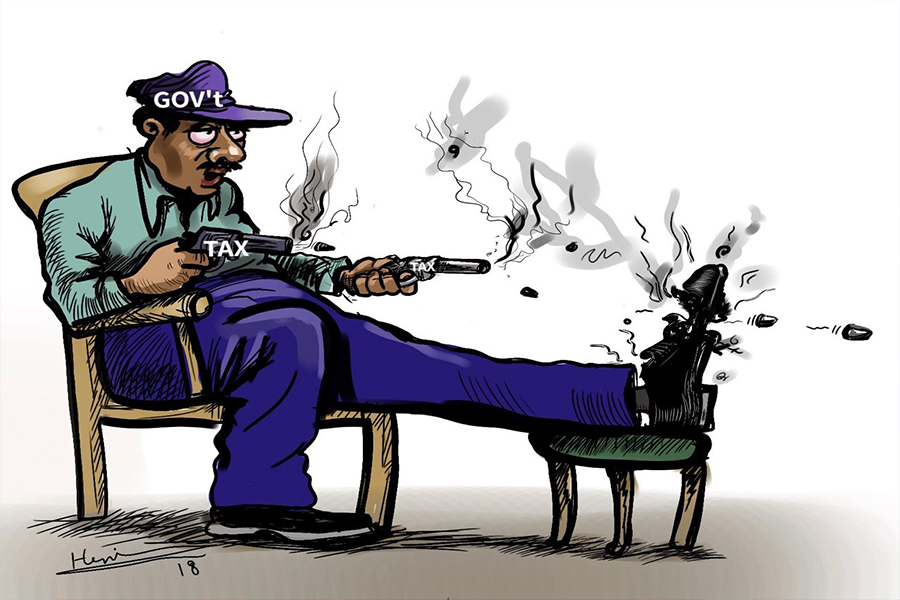
Ideally, citizens who have paid income tax all year should not have to reach for thei...
Jul 18 , 2026
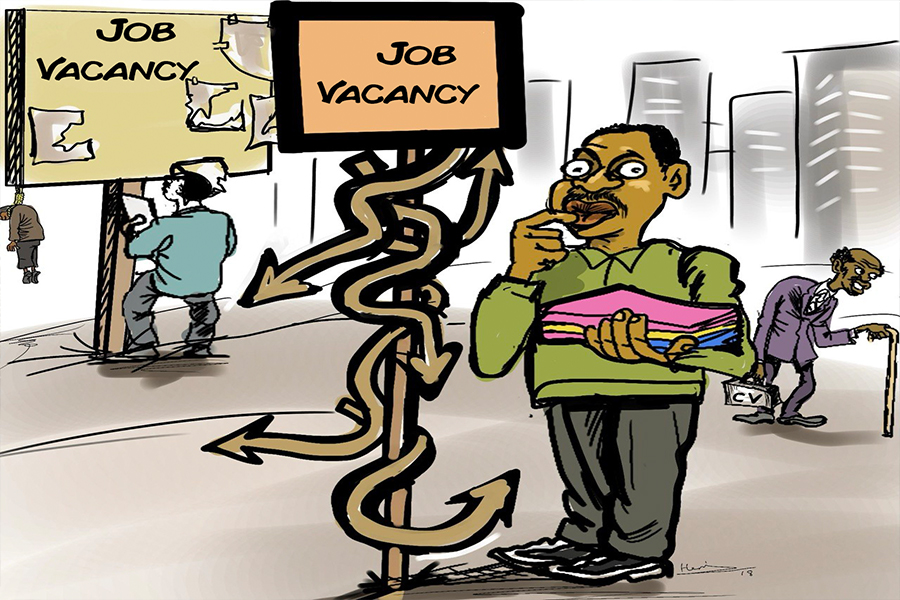
Pressed in Parliament on jobs and household incomes, Prime Minister Abiy Ahmed (PhD)...
Aug 9 , 2026 . By NAHOM AYELE
Anbesa Bank has elected an entirely new board of directors, nine months after the Boa...
Aug 9 , 2026 . By NAHOM AYELE
Ethiopia Hotel, one of the country's oldest hospitality establishments and a landmark...
Aug 9 , 2026 . By FITSUM TADESSE
The excise-tax reform on alcohol and tobacco has done much of what it was made to do...
Aug 9 , 2026 . By BEZAWIT HULUAGER and ABDUREUF JUHAR
Three inter-city transport companies have spent 450 million Br on new vehicles to mee...






 Loading your updates...