
Viewpoints | Aug 12,2023



Feb 27 , 2021
By Yehualashet Tamiru
Ancient Greece Philosopher Cicero once said that a rational discussion on any topic should first define the subject matter. Thus, it is critical to state what is meant by "globalisation."
As a result of numerous invocations in various media outlets and books, the term has entered everyday language without having a universally accepted single definition. Globalisation is so broad a phenomenon that comprehensive description now seems almost futile. Nevertheless, the Peterson Institute for International Economics offers a helpful definition:
“The growing interdependence of the world’s economies, cultures, and populations, brought about by cross-border trade in goods and services, technology, and flows of investment, people, and information.”
In some instances, globalisation is synonymous with terms such as internationalisation, liberalisation, universalisation, Westernisation and even deterritorialisation. Although there is a gulf of difference as to the advantages of globalisation, virtually no one denies its existence.
As we used to know it, the concept of sovereignty has been eroded by globalisation. Traditionally, sovereignty, which stems from the treaties signed during the Peace of Westphalia, are understood to mean that every state has complete autonomy to determine what is going on and will be going in their territory. This is known as the Westphalian sovereignty, and it dates back to the 17th century.
Things have changed over the last few centuries. There is a new understanding of international law, which is sometimes referred to as world law, supernatural law or cosmopolitan law, to distinguish from the traditional precept established in the Westphalian cities of German.
Current international law governs not only the relationship between states but also between states and individuals. The process of creating, interpreting and enforcing international law is also vastly different.
One such area where an individual can claim more rights than what is provided under national law is human rights. The Universal Declaration of Human Rights is a common standard of achievement for all people and nations that expands the rights of people and the obligation of the states. Subsequent to this, various international treaties such as the international conventions on Civil and Political Rights, as well as the Economic and Social Rights, widen the rights of the individual. These international instruments provide rights and access to individuals to prosecute a state at international forums such as the European Court of Human Rights and the African Court on Human & People’s Rights.
The effect of globalisation is also well reflected in the power of states to regulate a domestic economy. In the traditional concept of internal sovereignty, states virtually single-handedly determine their economic policies regarding tariffs, quotas, state subsidies and safety standards. However, with the increasing prominence of international corporations, this right has become eroded.
For instance, under the World Trade Organisation (WTO), member states are free to determine the amount of tariff they want to charge. However, once they decide on a maximum tariff, they cannot charge over this rate. On top of this, under the WTO, quota and voluntary export restraints are prohibited. Member states can impose an equivalent tariff on any other member country that violates this rule. These two key instruments have two purposes: open market access for foreigners while at the same time restricting the power of the state to regulate.
One of the cornerstones of international trade is the principle of non-discrimination. A member state is neither allowed to discriminate its products against those of other countries nor extend more favourable treatment to any single WTO member that does not apply to all others.
Although there are exceptional circumstances that allow deviation from the principle, there are stringent requirements to benefit from them. For instance, agreements on products and services that impact human, animal and plant health make it clear that a discriminatory measure should be taken only based on sufficient scientific evidence. The exception should not be used to constitute a disguise of a restrictive policy. On top of this, under the WTO system, the Trade Policy Review and the dispute settlement mechanisms substantially affect state sovereignty.
Another prominent effect of globalisation is the proliferation of international organisations that have a legal personality. For instance, the International Monetary Fund (IMF), under its Poverty Reduction & Growth Facility, requires borrower countries to incorporate good governance and reform their domestic policy by raising taxes, cutting expenses and lifting restrictions on financial flow. Likewise, since the 1960s, the World Bank has been consistent in adopting and enforcing policy-based lending, which requires borrowers to reform the civil service, state-owned enterprises and the justice system.
Taken together, such economic and political international legal policies constrain the power of the state to regulate social life. K. Mills captures the impacts of globalisation in his famous essay, “Reconstructing Sovereignty: A Human Rights Perspective.”
“The dividing line between international law and domestic law is becoming increasingly blurred … the principle of non-intervention which has been the link between the internal and external dimension of sovereignty, correspondingly weakens,” he wrote.
We live in a time where the absolute sovereignty of a state, as we used to know it, is no longer a reality. There is an ever-growing interdependency among states that make it nearly impossible for any given country to act independently as much as it would like.
Although there is no single definition for the term globalisation, its existence and impacts are undoubted. As a result, states split their sovereignty with various regional and global institutions. Moreover, globalisation has forced states to shape and reconsider their domestic and foreign policies, which has ultimately eroded one of the central and defining features of a state: sovereignty.
PUBLISHED ON
Feb 27,2021 [ VOL
21 , NO
1087]
Viewpoints | Aug 12,2023

Editorial | Aug 08,2026
Radar | Mar 16,2019
Fortune News | Apr 22,2023
Viewpoints | Sep 10,2022
Commentaries | Oct 15,2022
Radar | Oct 09,2021
Viewpoints | Dec 08,2024

Films Review | Jan 07,2022
Fortune News | May 18,2019

Photo Gallery | 193581 Views | May 06,2019

Photo Gallery | 183475 Views | Apr 26,2019

Photo Gallery | 180301 Views | Oct 06,2021

My Opinion | 145725 Views | Aug 14,2021





Dec 22 , 2024 . By TIZITA SHEWAFERAW
Charged with transforming colossal state-owned enterprises into modern and competitiv...

Aug 18 , 2024 . By AKSAH ITALO
Although predictable Yonas Zerihun's job in the ride-hailing service is not immune to...

Jul 28 , 2024 . By TIZITA SHEWAFERAW
Unhabitual, perhaps too many, Samuel Gebreyohannes, 38, used to occasionally enjoy a couple of beers at breakfast. However, he recently swit...
Jul 13 , 2024 . By AKSAH ITALO
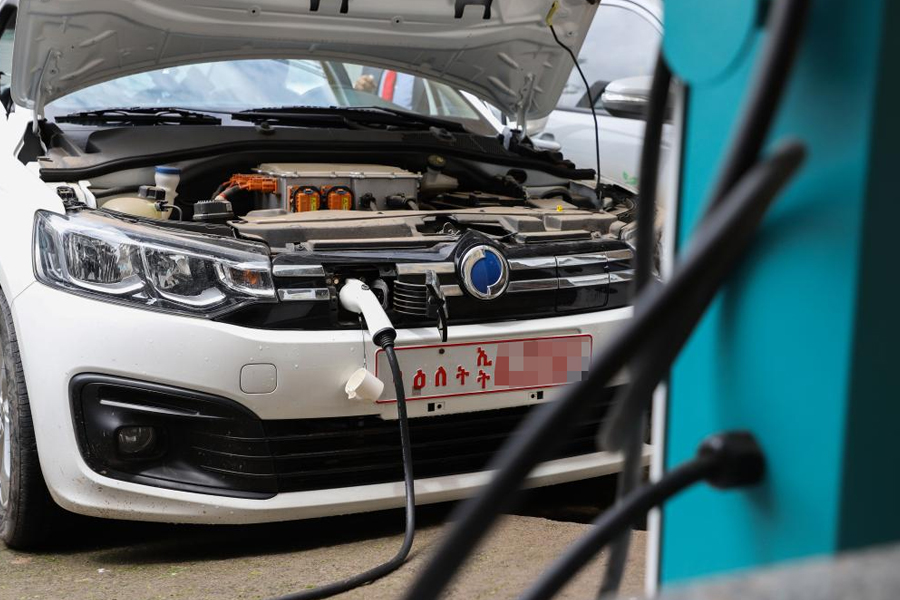
Investors who rely on tractors, trucks, and field vehicles for commuting, transporting commodities, and f...
Aug 22 , 2026
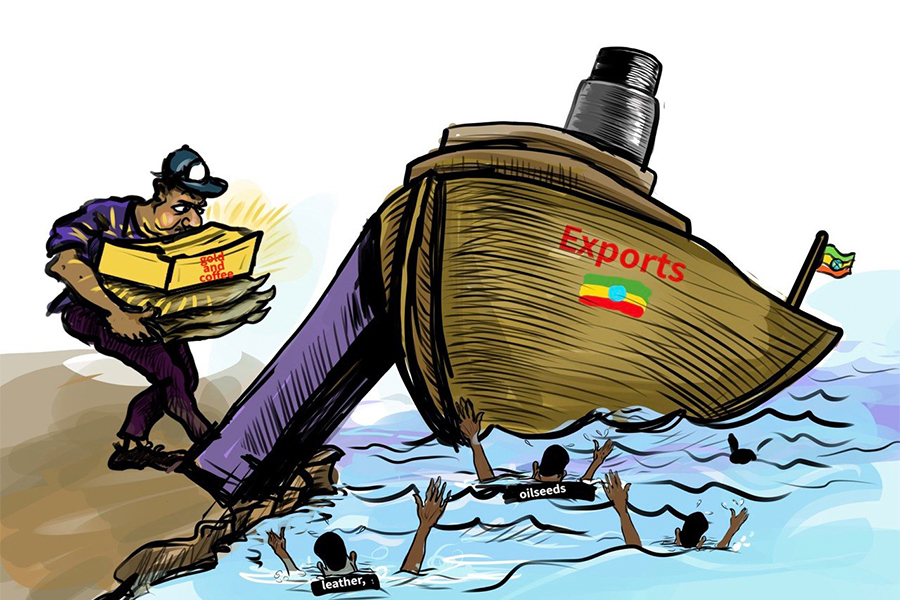
A record is a strange thing to worry about. Federal trade officials have booked the b...

Aug 14 , 2026
Aschalew Fetene, known as “Ardi” and admired for his poetic depth, has built a ti...
Aug 8 , 2026
The World Bank asks readers to picture a mother in rural Ethiopia who has never held...

Jul 31 , 2026
Weldu Yiheysh has not read the Pacific temperature charts. He does not need to. In Shibta District of Enderta Wereda, in...
Aug 22 , 2026 . By BEZAWIT HULUAGER
The forthcoming strategy for interest-free finance will place Sharia-compliant financ...
Aug 22 , 2026 . By NAHOM AYELE
Wegagen Capital Investment Bank (WCIB) has completed its first full year in profit an...
Aug 22 , 2026 . By NAHOM AYELE
Judges at the Federal High Court, sitting on a limited basis to hear only urgent matt...
Aug 22 , 2026 . By BEZAWIT HULUAGER
Federal authorities are about to find out whether they can make a single payment wind...






 Loading your updates...