

Radar | Aug 13,2022



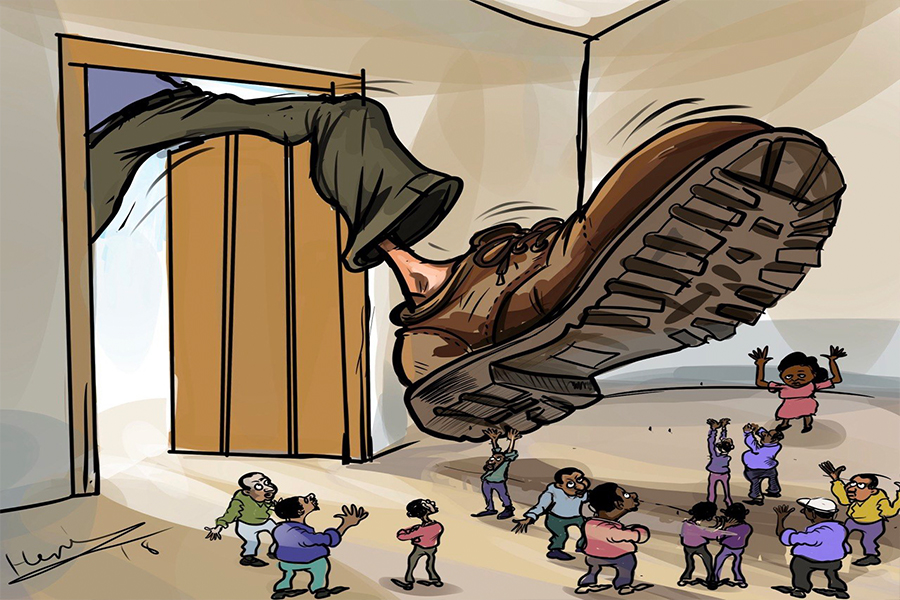
Environmental protection officials in Addis Abeba are preparing surveys to determine which businesses should submit mandatory environmental and social management plans, following confusion over letters sent to small and medium-sized enterprises.
Letters from district offices ordered businesses to submit plans within two weeks, detailing a company’s environmental interactions, how the area would be protected from pollution, and how the plan would be reported to the responsible authority. However, business owners say the letters failed to state penalties for noncompliance, causing fears of corruption.
Officials at the Addis Abeba Environmental Protection Authority (AAEPA) say the requirement is not based solely on the sector, but on how businesses operate and their impact on the city's environment. Companies deemed to pose environmental risks, attract complaints, or generate pollution will be expected to submit management plans to their respective districts and provide implementation roadmaps.
According to Lemessa Gudeta, head of the environmental law administration department at the Authority, businesses in the city are expected to manage liquid and solid waste and control noise pollution.
“It isn't about the nature of the business," he told Fortune. "It's about how the businesses are functioning.”
Nonetheless, Lemessa acknowledged that requiring every business to respond through consultancy services would impose a financial burden.
That burden is central to complaints from business owners like Yordanos Geoush, a new mother and owner of Melaika African Grill on Egypt Street in the Mekanisa area. She supports the intention behind the environment bureau officials in Nifas Silk-Lafto District, but found the timeline and the cost involved make compliance unrealistic for a small restaurant. Her business serves at most 10 dishes a day and, on some days, sells as few as one.
According to Yordanos, she was told compliance could cost between 300,000 Br and 500,000 Br. For a business of her size, she found that such an expense was overwhelming, especially coming after tax season. Her neighbours also received what she called the same “threat.” Yordanos claims to have no prior knowledge of the law and feels it was being imposed on businesses without their knowledge or awareness.
“It isn't right to threaten me without informing me," she told Fortune. "It should not be a check box.”
The Authority's officials now conceded that some of the letters were sent mistakenly. According to Lemessa, a misunderstanding in which some small shops received notices they should not have received. The Authority has moved to stop the process and rectify the mistake.
However, city officials argued that the broader campaign was intended to address problems affecting 16,000 projects and homeowners. More than half have already been handled, with some resolved through fines and others corrected with the Authority.
Addis Abeba lacked a comprehensive system for waste disposal and pollution management, according to the Authority. Officials argue that a problem developed over many years cannot be fixed overnight.
Eshetu Lemma (PhD), head of the Authority, defended the letters, claiming they were sent in response to complaints from affected communities.
“Every district has a complaint about the companies that received the letter,” he told Fortune.
The Authority blames bars and restaurants as major sources of noise pollution, as well as liquid and solid waste that contaminate surrounding areas. For large projects, developers are required not only to submit management plans but also to provide an Environmental Impact Assessment.
“People think this is easy, the impact isn't,” said Eshetu.
The letters touched a fault line in a city under environmental stress. Addis Abeba’s population grew from 2.3 million in 2000 to over five million this year, fueling urban expansion that worsened traffic, pollution and housing shortages, according to a pollution management survey released by the World Bank. The report found air quality in the city is now 1.6 times worse than in the 1970s, exceeding World Health Organisation (WHO) safety limits in 90pc of samples taken in 2015 and 2016.
Vehicles account for 29pc of pollutants, particles about 30 times thinner than a human hair. Vehicles also account for more than 90pc of carbon and up to 35pc of the city’s air pollution, causing heart and lung diseases, leading to around 1,600 premature adult deaths. The World Bank estimates the health cost at 78 million dollars, 1.3pc of Addis Abeba’s GDP.
Water quality is also deteriorating. Rivers are polluted by metals, nutrients, and non-point sources, such as runoff, septic failures, and open defecation, as well as point sources, such as factory effluents. In Lafto District, 24.8pc of residents suffered sanitation-related diseases.
Two decades ago, the city recorded more than 14,000 typhoid cases, nearly 9,000 diarrhoea cases with blood, and more than 10,000 severe dehydration cases among children under five, causing 89 child deaths.
Solid waste is another challenge. Cities generate 70pc of the national total solid waste, and Addis Abeba alone produces six million tons a year, projected to reach 10 million tons by 2030.
Haile Mekonnen is an environmental and social governance expert. He argued that small businesses have limited capacity to meet such requirements, insisting that regulators should use alternative approaches for smaller operators. Larger buildings and developments should be treated as projects and required to conduct proper due diligence, rather than placing the same burden on small households and businesses.
"Restaurants, shops and other small enterprises have a much smaller environmental footprint," he said. "Enforcing the same requirement on them may prove difficult in practice."
Haile's concern is not mainly about cost. Consultancy services can be secured for as low as 50,000 Br if expenses are minimised. According to Haile, similar requirements are becoming more common in banking as lenders increasingly seek environmental, social, and governance assessments to ensure businesses are not exposed to environmental or social risks that could lead to failure.
PUBLISHED ON
Mar 14,2026 [ VOL
26 , NO
1350]
Radar | Aug 13,2022
Radar | Feb 10,2024
Radar | Dec 01,2024

Delicate Number | Aug 30,2025
Radar | Jun 29,2019

Dec 22 , 2024 . By TIZITA SHEWAFERAW
Charged with transforming colossal state-owned enterprises into modern and competitiv...

Aug 18 , 2024 . By AKSAH ITALO
Although predictable Yonas Zerihun's job in the ride-hailing service is not immune to...

Jul 28 , 2024 . By TIZITA SHEWAFERAW
Unhabitual, perhaps too many, Samuel Gebreyohannes, 38, used to occasionally enjoy a couple of beers at breakfast. However, he recently swit...

Jul 13 , 2024 . By AKSAH ITALO
Investors who rely on tractors, trucks, and field vehicles for commuting, transporting commodities, and f...
Jul 4 , 2026
In the goldfields of the Benishangul-Gumuz Regional State, Ethiopia's balance-of-paym...
Jun 27 , 2026
The federal legislative house rushed through one of the country's most contentious ho...
When Parliament takes up the appropriation bill, federal legislators will receive a d...
Jun 13 , 2026
The recent policy decision to fully open freight forwarding to foreign capital may be...













 Loading your updates...