

Viewpoints | May 27,2023



Dec 23 , 2025
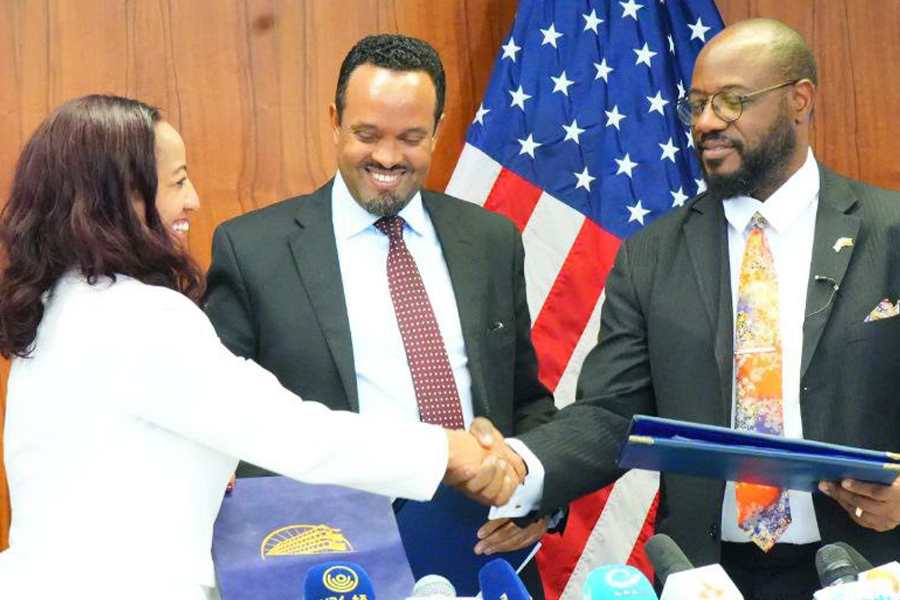
The United States has pledged nearly 1.5 billion dollars to support Ethiopia’s health sector over the next five years, signalling a thaw in relations after years of limited cooperation.
The deal, signed today, December 23, 2025, at the Ministry of Finance in the presence of Ahmed Shide, finance minister, and with U.S. Ambassador to Ethiopia, Ervin Massinga, marks the first major bilateral agreement between the two countries since the Trump Administration took office this year.
Under the memorandum of understanding, Washington will contribute up to 1.016 billion dollars, while the federal government will put forward 450 million dollars.
"Our commitment from our domestic resources reflects our determination to increase national investment in health. These investmentsaren't costs but the foundation of economic productivity and inclusivedevelopment, " said Ahmed. "Health securities know no borders and essential for national regional and global stability."
The agreement, signed with Health Minister Mekdes Daba (MD), outlines a broad health agenda that includes combating HIV/AIDS, tuberculosis, malaria, polio eradication, maternal and child health, as well as outbreak response, but lacks immediate operational details.
“This is a clear example of sustainable co-investment and mutualaccountability,” said Ambassador Massinga during the signing ceremony, noting that the U.S. has invested more than five billion dollars in Ethiopia’s health sector over the past two decades.
Much of this funding has come through the President’s Emergency Plan for AIDS Relief (PEPFAR), which American officials estimate has spent around three billion dollars in Ethiopia. That funding has underpinned the country’s HIV response and funded a range of infrastructure, including labs, digital records, and surveillance systems.
PEPFAR’s labs, initially established for HIV testing, became instrumental during the COVID-19 pandemic. The program also contributed to Ethiopia’s disease surveillance capacity and laid the foundation for its emerging digital health systems.
Through the U.S. President’s Malaria Initiative, American support has included insecticide-treated bed nets, rapid diagnostic kits, and antimalarial treatments, interventions that have proven vital in a country where malaria risk is exacerbated by climate variability and internal displacement.
While high-profile infectious diseases attract attention, much of the American assistance operates behind the scenes. The now-defunct USAID led efforts to improve maternal and child health, nutrition, family planning, and water and sanitation. These included funding for frontline clinics, medical supply chains, training programs, and health-worker supervision, along with modernisation efforts in digital data systems.
"The agreement affirms our long-standing commitment and builds on more than 120 years of bilateral relationships between our two countries," said the Ambassador.
It is a voice echoed by Minister Ahmed who characterised today’s signing as "a continuation of the enduring partnership and reaffirmation of" shared commitment "for the wellbeing of our people."
For years, U.S. assistance has been a pillar of Ethiopia’s strained health system. It has supported from antiretroviral drugs and vaccine cold chains to maternal care services. The U.S. remains Ethiopia’s top bilateral health partner, delivering hundreds of millions of dollars annually even during political uncertainty, conflict, and severe drought.
But these efforts have not gone unchallenged. The recent civil war in the north and drought that began in 2020 strained government capacity, redirected priorities to basic services, and caused interruptions in immunisation, nutrition screening, and chronic disease care. As conflict surged, American health funding was increasingly routed through humanitarian channels.
In 2023, USAID suspended food aid to Ethiopia after discovering widespread diversion, a move that sent ripple effects through linked health and nutrition programs. The Agency's restructuring and funding freezes in 2025 further disrupted U.S. development assistance, reducing its predictability.
Despite the turbulence, American aid has remained substantial. In recent years, annual assistance stayed between 250 million and 300 million dollars, positioning Ethiopia among the top recipients of U.S. health aid in Africa. However, American officials say these figures understate the scale of involvement, as sizable allocations for health and nutrition have been embedded within emergency humanitarian budgets, blurring the distinction between development aid and crisis response.
Earlier this year, a new 111 million dollar package was approved under PEPFAR to help Ethiopia reach its goal of ending AIDS as a public health threat by 2030. The American commitment, though substantial, depends on future planning. The newly signed memorandum remains a framework rather than a funded blueprint, relaying on forthcoming operational plans to move to practice.
Viewpoints | May 27,2023
Viewpoints | Sep 01,2024
Radar | Apr 19,2025
Viewpoints | Apr 03,2021
Commentaries | Apr 26,2019

My Opinion | Jul 22,2023
Fortune News | Sep 13,2025
Commentaries | Apr 06,2019
Editorial | Jan 27,2024
Viewpoints | Jan 16,2021

Photo Gallery | 185867 Views | May 06,2019

Photo Gallery | 175908 Views | Apr 26,2019

Photo Gallery | 171474 Views | Oct 06,2021

My Opinion | 139417 Views | Aug 14,2021



May 9 , 2026
The Ethiopian state appears to have discovered a fiscal instrument that is politicall...
May 2 , 2026
By the time Ethiopia's National Dialogue Commission (ENDC) reached the end of its fir...
Apr 25 , 2026
In a political community, official speeches show what governments want their citizens...

For much of the past three decades, Ethiopia occupied a familiar place in the Western...







 Loading your updates...