

Fortune News | Mar 09,2024



Oct 14 , 2023
By Avinash D. Persaud , Chris Humphrey
The world is confronting its most significant threat with one arm tied behind its back. Although the increasingly devastating effects of the climate crisis are becoming more apparent with each passing year, multilateral development banks (MDBs) are still playing only a marginal role in the global response. Last week’s annual World Bank and the International Monetary Fund (IMF) meetings would be a crucial opportunity to change course.
Recent events in Libya, Pakistan, and the Horn of Africa confirm a hard, tragic truth: climate disasters are now firmly intertwined with development. The global system of AAA-rated MDBs – with the World Bank at its centre – should be at the heart of financing climate-change mitigation and adaptation efforts in the developing world. Yet they are not stepping up.
Total MDB lending hovers around 100 billion dollars annually, and, as the recent report of the G20 Independent Expert Group on MDBs points out, net transfer from MDBs to developing countries is currently close to zero, or even turning negative, once debt repayments are factored in. Compare that to the estimate by the Independent High-Level Expert Group on Climate Finance that we need an additional 2.4 trillion dollars a year for climate and development finance.
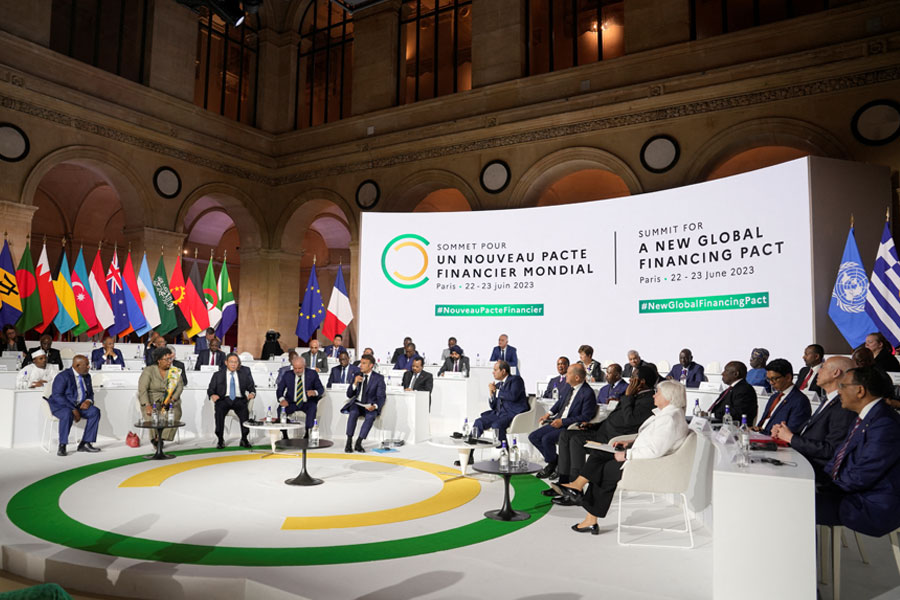
More initiatives are needed to unblock the flow of private capital to green projects in developing countries. To that end, the Summit for a New Global Financing Pact in Paris this summer introduced a proposal for a partial foreign exchange guarantee to protect investors more cheaply from losses associated with volatile exchange rate fluctuations in developing countries. That is a critical step forward. But many categories of climate investment – including resilient infrastructure (such as stronger sea-level and flood defences) and climate-resilient health and education systems – do not generate enough revenue to attract private-sector players.
Different climate-financing needs call for different financing methods, which is why Barbadian Prime Minister Mia Amor Mottley’s Bridgetown Initiative advocates addressing climate finance as a holistic global system. When building resilience in developing countries, MDBs must take the lead.
We already know the scale of the adaptation-finance gap. In its widely discussed November 2022 report, the Independent High-Level Expert Group on Climate Finance – led by Vera Songwe, Nicholas Stern, and Amar Bhattacharya – estimated that an extra 200 billion dollars of annual MDB spending is needed to protect lives and livelihoods from climate change across the developing world.
We also know how to fill this gap with minimal additional capital from governments.
Extrapolating from a recent analysis published by the Rockefeller Foundation, MDBs could be lending 75 billion dollars more per year with their existing capital and credit rating if they apply the recent recommendations of the G20’s Independent Review of MDB Capital Adequacy Frameworks. Key measures include increasing the amount MDBs can lend with existing capital while maintaining credit quality; extracting more value from callable capital (an under-used shareholder guarantee already on the books at all MDBs); and standardising how the credit-rating agencies and MDBs treat capital.
MDBs could boost annual lending by another 25 billion dollars if shareholders extended guarantees to de-risk a portfolio of climate-related MDB loans. In practice, such guarantees require a few dollars, because the likelihood of an AAA-rated lender’s entire portfolio going underwater is low. And MDBs already rank higher than anyone else when it comes to recovering troubled loans. The budgetary impact for shareholders is nominal.
There is no better way to leverage a dollar. The Education Commission, chaired by former UK Prime Minister Gordon Brown, an early proponent of guarantees, argues that it takes only one dollar of backing to cover a loan portfolio of 27 dollars. And last month, at the New Delhi G20 Summit, US Secretary of the Treasury Janet Yellen proposed a similar (albeit more modest) approach.
Finally, an additional 100 billion dollars of annual lending could be mobilised if MDB shareholders put up just 10 billion more annually for the next 10 years, as recently proposed by the G20 Independent Expert Group on MDBs, chaired by N. K. Singh and Lawrence H. Summers. Assuming shareholding roughly similar to the World Bank, annual contributions across the entire MDB system would amount to approximately 400 million dollars each from Britain and France, 450 million from Germany, 600 million from China, and 1.6 billion dollars from the United States.
To put these numbers in perspective, consider that the US spent 113 billion dollars (with ample justification) supporting Ukraine in 2022. That is almost 100 times more than what it would need to contribute to help transform development and climate finance. Likewise, Britain and Canada have also spent a high multiple of their potential MDB contributions on military aid.
We already know what needs to be done. It should not take another summer of record-breaking heat, floods, droughts, and climate-related deaths to shake us from our complacency and inaction. But only the MDBs’ principal shareholders can help developing countries realise their ambitions, lifting annual lending by the 200 billion dollars that is needed.
Archimedes famously said, “Give me a lever long enough, and I can move the world.” The system of AAA-rated MDBs with preferred creditor status is that lever. It makes no sense not to use it.
This article is provided by Project Syndicate (PS).
PUBLISHED ON
Oct 14,2023 [ VOL
24 , NO
1224]
Fortune News | Mar 09,2024
Commentaries | Jan 03,2026
Commentaries | Jun 25,2022
Radar | Jan 01,2023

My Opinion | Apr 17,2021
Fortune News | Mar 12,2022

Viewpoints | Nov 09,2024
Exclusive Interviews | Jun 24,2023
Money Market Watch | May 17,2026
Fortune News | Oct 18,2025

Photo Gallery | 193170 Views | May 06,2019

Photo Gallery | 183059 Views | Apr 26,2019

Photo Gallery | 179846 Views | Oct 06,2021
My Opinion | 145306 Views | Aug 14,2021







Dec 22 , 2024 . By TIZITA SHEWAFERAW
Charged with transforming colossal state-owned enterprises into modern and competitiv...

Aug 18 , 2024 . By AKSAH ITALO
Although predictable Yonas Zerihun's job in the ride-hailing service is not immune to...

Jul 28 , 2024 . By TIZITA SHEWAFERAW
Unhabitual, perhaps too many, Samuel Gebreyohannes, 38, used to occasionally enjoy a couple of beers at breakfast. However, he recently swit...

Jul 13 , 2024 . By AKSAH ITALO
Investors who rely on tractors, trucks, and field vehicles for commuting, transporting commodities, and f...
Aug 14 , 2026
Aschalew Fetene, known as “Ardi” and admired for his poetic depth, has built a ti...

Aug 8 , 2026
The World Bank asks readers to picture a mother in rural Ethiopia who has never held...

Jul 31 , 2026
Weldu Yiheysh has not read the Pacific temperature charts. He does not need to. In Shibta District of Enderta Wereda, in...
Jul 25 , 2026
Ideally, citizens who have paid income tax all year should not have to reach for thei...
Aug 15 , 2026 . By NAHOM AYELE
Federal prosecutors have charged seven defendants over a set of foreign-trade deals t...
Aug 15 , 2026 . By BEZAWIT HULUAGER
Ethio-post is preparing to turn its thousands of branches into banking agents, allowi...
Aug 16 , 2026 . By BEZAWIT HULUAGER
Kassahun Gofe (PhD), minister of Trade & Regional Integration (MoTRI), is prepari...
Aug 16 , 2026 . By NAHOM AYELE
Justices at the Federal Supreme Court widened the shield they are holding over lawyer...





 Loading your updates...