
Commentaries | May 25,2019



May 28 , 2022
By Christian Tesfaye
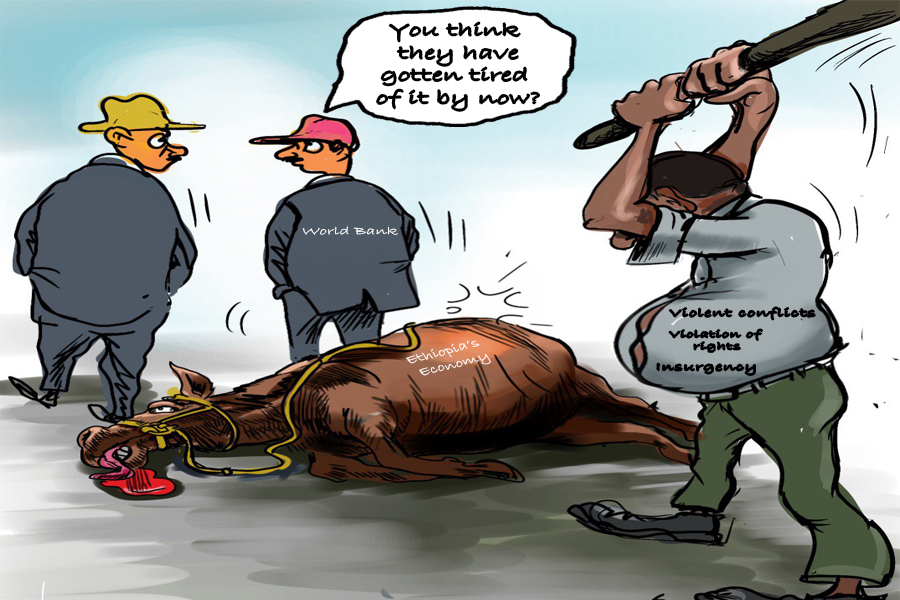
Ethiopia’s economy ails from three fundamental and structural diseases that are self-inflicted. One is energy subsidies, aka fuel subsidies, which are bleeding federal budgets and distracting from pro-poor policies. It does not help stop inflation in the true sense because the government is deficit financing through central bank advances to support the subsidies. It does not help the poor because it is those in the higher income quantile that have the highest energy per capita consumption, and thus benefit the most.
The other self-inflicted ailment is the foreign exchange regime. It ensures that formal channels are starved of foreign currency while the black market has high levels of it. Recently, there were reports of shortages of raw materials for license plates. This is bizarre because it also means that there is enough foreign currency in the economy to import vehicles, which are much more expensive than license plates. It all makes sense, though, considering that license plates are funded using foreign currency from the formal channels while it is the black market that finances Addis Abebe’s burgeoning car import market. Ethiopia does not have a foreign currency problem. It has a black money market crisis.
Adding to these disasters is the long-held central bank stance that capital markets and foreign banks will have a negative impact. Equating capital markets to gambling platforms was ludicrous; much more of an ideological rhetoric than one grounded in economic fact. The decision to ban foreign competition is nonsensical when considering that local banks do not provide value to citizens in terms of helping the average Ethiopian access to credit but a few well-connected business types; why would such institutions be protected from the competition?
It is due time that this sad situation is addressed. Structural and regulatory reforms need to be enacted to ensure that the economy can wake from its slumber. But there is a response that comes up to such prescriptions these days; one that does not have to do with the rationale of such reforms.
But what about the timing? Are states of war and instability the right environments?
As an argument against following the highest possible caution, it is the proper response. For instance, lifting capital controls does require greater debate and reflection. But most other reforms are not just enactable. They are necessary.
Ethiopia’s political crisis did not start two years ago. It started six years ago. The current war may go on for 10 or more years. No one knows. Should we hold back necessary reforms to wait for the ideal time, then?
In fact, it could be improving the structural dilemmas in the economy that will help the political situation. No one said this would be easy. Development is always messy, and it is not a given (at least, it seems, in Africa’s case). Opening up, like in the telecom sector, needs to take place however bumpy the road may be or intimidating the challenge. Countries that opt to wait for the ideal time will never get there; the time to act is now.
The energy that the country should channel should be of one that has its fate in its hands, however hard things may seem when the going gets tough. Leaders should never be resigned to accepting their fate and hoping for the best, assuming the political situation will figure itself out. Ethiopia’s economic opening-up cannot wait, and neither can it be outsourced to political elites. We need to take our economic fate into our hands. If the political situation improves along the way, then great. If it does not, then we should work around it.
PUBLISHED ON
May 28,2022 [ VOL
23 , NO
1152]

Commentaries | May 25,2019
Radar | Oct 14,2023
Verbatim | Jun 28,2025
Agenda | Dec 01,2024
Editorial | Mar 01,2024

View From Arada | Feb 20,2021
Fortune News | Sep 30,2023

My Opinion | Jan 05,2019
Covid-19 | Jul 18,2021
My Opinion | Jul 17,2022

Photo Gallery | 193231 Views | May 06,2019

Photo Gallery | 183114 Views | Apr 26,2019

Photo Gallery | 179914 Views | Oct 06,2021

My Opinion | 145359 Views | Aug 14,2021








Dec 22 , 2024 . By TIZITA SHEWAFERAW
Charged with transforming colossal state-owned enterprises into modern and competitiv...

Aug 18 , 2024 . By AKSAH ITALO
Although predictable Yonas Zerihun's job in the ride-hailing service is not immune to...

Jul 28 , 2024 . By TIZITA SHEWAFERAW
Unhabitual, perhaps too many, Samuel Gebreyohannes, 38, used to occasionally enjoy a couple of beers at breakfast. However, he recently swit...

Jul 13 , 2024 . By AKSAH ITALO
Investors who rely on tractors, trucks, and field vehicles for commuting, transporting commodities, and f...

Aug 14 , 2026
Aschalew Fetene, known as “Ardi” and admired for his poetic depth, has built a ti...

Aug 8 , 2026
The World Bank asks readers to picture a mother in rural Ethiopia who has never held...

Jul 31 , 2026
Weldu Yiheysh has not read the Pacific temperature charts. He does not need to. In Shibta District of Enderta Wereda, in...
Jul 25 , 2026
Ideally, citizens who have paid income tax all year should not have to reach for thei...
Aug 15 , 2026 . By NAHOM AYELE
Federal prosecutors have charged seven defendants over a set of foreign-trade deals t...
Aug 15 , 2026 . By BEZAWIT HULUAGER
Ethio-post is preparing to turn its thousands of branches into banking agents, allowi...
Kassahun Gofe (PhD), minister of Trade & Regional Integration (MoTRI), is prepari...

Aug 16 , 2026 . By NAHOM AYELE
Justices at the Federal Supreme Court widened the shield they are holding over lawyer...






 Loading your updates...