

Radar | Jan 29,2022



Apr 20 , 2019
By Eskender Mulugeta
Eskender Mulugeta is founder and project director of Food Secured Schools Africa, which promotes gardening in Adiss Abeba’s schools. He can be reached at eskyau@gmail.com.
One of the most urgent development challenges of the 21st century is combating poverty in Sub-Saharan Africa. Poverty is higher in most of these countries than elsewhere in the developing world. Most of them have real growth rates of less than five percent and about a third of all Africans live below the poverty line.
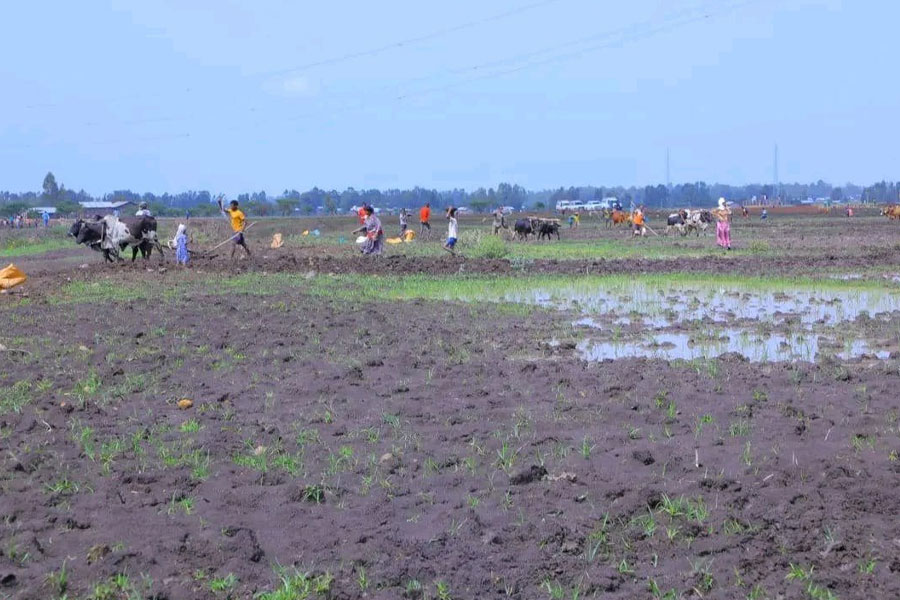
Ethiopia, one of the poorest countries in the world, suffers from the same problem. But growing up, we used to eat well, and there was plenty of food in our house. This was due to farmers like my grandmother, who owned three hectares that fed not only six household members but also paid 10pc of its yield in taxes.
The harvest was plenty, and she recalled that 15 to 20 sacks of maize were produced from every hectare without any inputs such as artificial fertilizer. She said the land was very productive, and she wonders why these same fields are declining in productivity, even if farmers are now using new technologies such as improved seeds and fertilizers.
Indeed, food production per capita has declined by 17pc in Ethiopia since the 1970s - so my grandmother was right. Research and development investments in agriculture were made, but they were very poor in terms of implementation. Lack of funding is also another challenge of African governments.
There are nonetheless experiences Ethiopia can look to in its African peers to ensure food security and transform the agriculture sector. One of them is Uganda, which exports food items such as maize and beans and even milk to South Sudan, Kenya and Rwanda. Uganda by 2016 had the largest area under organic farming in Africa, only second globally to India.
The country adopted policies in the late 2000s aimed at creating an enabling environment for growing, processing and marketing organic products.
Urban agriculture and school gardening are widely practiced in Uganda. I visited one school that is food secure all year long as a result. The social value of agriculture being very high means people moving into the sector with full interest. Most importantly, Uganda has a strong educational policy and curriculum that includes agriculture as a subject.
And while Uganda does have poor infrastructure, marketing is active. Smallholders have become major beneficiaries since the government gives incentives such as tax cuts to private players that buy agricultural products from smallholder farmers.
The outcome of these efforts have not disappointed, Ugandan farmers are now enjoying improved income and food security due to reduced agricultural chemical runoff and certified organic export revenues. Milk in Uganda costs three-quarters of what it does in Ethiopia.
This is while in Tanzania, agricultural research centres take up two percent of the nation’s annual budget. The centres have the mandate to produce at least two new research products every year targeting smallholder farmers. There is even a national slogan, “kilmokaza,” loosely translated as “Agriculture First,” showing that they ascribe great value to the sector.
Another country from which experiences can be gained is Malawi. Incentives and support from the government give smallholders an easier possibility of organising and moving into commercial farming. In Kenya, they use technologies such as mobile applications that can conduct soil testing, which have contributed to the nation being able to counter infestations such as fall armyworm early.
One of the most important experiences Ethiopia should adopt is improving private sector involvement in the agricultural sector. This though does not mean that commercial agriculture should be encouraged at the expense of smallholder farmers. This is actually what is taking place when it comes to flower farms that employ 20 people a hectare – which is not sustainable given an exploding population and decreasing land resources.
Notably, in Uganda, smallholders are made to benefit from commercial companies located close by in terms of getting training and knowledge and experience sharing. Private players are as well encouraged to maintain existing infrastructure so farmers have easy access to markets. Farmers are thus economically empowered, and their business is sustainable.
Ethiopia’s government needs to strive to create a suitable environment for smallholders to work with the private sector, especially by helping them mobilise and ensuring they get loans in commercial farming projects.
Strong government regulation is also needed to control agricultural projects and implement sustainable strategies as well as more investment in research centres to find country-specific ways of addressing the problem.
There also needs to be an agency dedicated to waste management, composting and recycling to restore soil fertility. Encouraging the local private sector to be involved in agriculture would be helpful as well.
PUBLISHED ON
Apr 20,2019 [ VOL
20 , NO
990]

Radar | Jan 29,2022

My Opinion | Apr 20,2024

Radar | Apr 05,2026

Viewpoints | May 29,2021
Fortune News | May 04,2025

My Opinion | Sep 08,2024

Radar | Nov 22,2025
Commentaries | May 31,2025

Radar | Apr 27,2025
Sunday with Eden | May 24,2025

Photo Gallery | 193112 Views | May 06,2019

Photo Gallery | 183003 Views | Apr 26,2019

Photo Gallery | 179785 Views | Oct 06,2021
My Opinion | 145251 Views | Aug 14,2021









Dec 22 , 2024 . By TIZITA SHEWAFERAW
Charged with transforming colossal state-owned enterprises into modern and competitiv...
Aug 18 , 2024 . By AKSAH ITALO
Although predictable Yonas Zerihun's job in the ride-hailing service is not immune to...

Jul 28 , 2024 . By TIZITA SHEWAFERAW
Unhabitual, perhaps too many, Samuel Gebreyohannes, 38, used to occasionally enjoy a couple of beers at breakfast. However, he recently swit...

Jul 13 , 2024 . By AKSAH ITALO
Investors who rely on tractors, trucks, and field vehicles for commuting, transporting commodities, and f...

Aug 8 , 2026
The World Bank asks readers to picture a mother in rural Ethiopia who has never held...

Jul 31 , 2026
Weldu Yiheysh has not read the Pacific temperature charts. He does not need to. In Shibta District of Enderta Wereda, in...

Jul 25 , 2026
Ideally, citizens who have paid income tax all year should not have to reach for thei...
Jul 18 , 2026
Pressed in Parliament on jobs and household incomes, Prime Minister Abiy Ahmed (PhD)...
Aug 9 , 2026 . By NAHOM AYELE
Anbesa Bank has elected an entirely new board of directors, nine months after the Boa...
Ethiopia Hotel, one of the country's oldest hospitality establishments and a landmark...
Aug 9 , 2026 . By FITSUM TADESSE
The excise-tax reform on alcohol and tobacco has done much of what it was made to do...

Aug 9 , 2026 . By BEZAWIT HULUAGER and ABDUREUF JUHAR
Three inter-city transport companies have spent 450 million Br on new vehicles to mee...






 Loading your updates...