

My Opinion | Sep 16,2023



Sep 14 , 2019
By Asseged G. Medhin
Economic policy and policy reform over the last few decades have been motivated by the need to accelerate growth. The result it has brought so far is at least acceptable by any standard.
However, the ideology of the leading party and its twin, the Revolutionary Democracy and Developmental State models, have not succeeded in cascading real democracy to the people.
On the other hand, in the economic literature or economic theories, the debates and disagreements about the determinants of growth have burgeoned. There is no consensus on the policy prescriptions for growth. But this much is clear; there is no country that has a non-developmental policy regardless of their position on the nationalisation to the liberalisation spectrum.
Ethiopia’s position is unique in that its economic policy is constitutionally depicted as the free market variety and yet almost every sector is purely dominated by governmental entities that are activated against their establishment proclamations. It resembles nationalisation more than it does a free market.
It can be argued that the two decades of growth is a result of state dominance, not one gained through diversified economic interactions, dynamism and proper competitive markets. The kind of free market that was being demanded by numerous investors since the days of the downfall of the Derguehas not been established.
Some argue that the developmental model is the fastest way to growth and cite the examples of Singapore, South Korea and China. The question is, how about UAE, Ghana, South Africa, India and Brazil?
Sometimes the disagreement between the revolutionists and the neoliberals is exaggerated by the titans of economic sciences way beyond the interests of the general public. Each of them tried to distinguish themselves from those constituting the conventional wisdom on economic growth.
Ethiopia, having concluded that liberalism has come to a dead-end, designed the state-dominated developmental state model. Even though this has initially benefited a lot of people by lifting them from the abject poverty of the early 80s and 90s, it has turned out to be more of a curse than a blessing, because the economy is dying of the lack of dynamism and free competition. All the current macroeconomic problems are emanating out of the inherent processes of the model itself.
By limiting the exercise of the constitutional right of private participation in the economy, the model creates a corruption loop between the party and state apparatus and their cronies. Following these critical perils of the model, there has to be a shift to an economic reform agenda that follows a different growth model, which is a liberal economic model.
I would argue that there should be an iterative discourse that shifts the perspective of professionals from debating the most trivial details to discussing macro ideas. Debating real issues of policy formulation and policy change and exploring the links between policy and institutions in the context of economic reforms is essential.
This dialogue should be clearly framed and mapped out until every citizen meaningfully understands what is going on in economic reform. That also means an extended debate cascading through institutions.
The successful introduction of economic reforms in the last year (Abiynomics) require strengthening institutions and the degree of success in changing policies may depend on the degree to which existing institutions are modified to accommodate the change.
We have seen many motivating issues recently that clearly indicate where the reform is directed. These include privatisation of governmental enterprises, readiness to join WTO, signing of the African Continental Free Trade Agreement, actively participating in regional integration, pooling out of state borrowing, bilateral agreements with countries and regional organisations. All in all, a very liberal direction.
The change in the political landscape is leaning toward liberalism. The economic reform should also aggressively lean toward a globalised, liberal and hi-tech economic model. That is the only way it will catapult the Ethiopian economy upwards.
PUBLISHED ON
Sep 14,2019 [ VOL
20 , NO
1011]

My Opinion | Sep 16,2023

Fortune News | Jan 05,2019
Radar | Apr 27,2025
Radar | Aug 16,2026

Advertorials | Dec 06,2023
Verbatim | Oct 28,2023

Commentaries | Feb 13,2021
Agenda | Apr 03,2021
Radar | Jul 12,2026
My Opinion | Aug 16,2020

Photo Gallery | 193614 Views | May 06,2019

Photo Gallery | 183511 Views | Apr 26,2019

Photo Gallery | 180337 Views | Oct 06,2021
My Opinion | 145761 Views | Aug 14,2021








Dec 22 , 2024 . By TIZITA SHEWAFERAW
Charged with transforming colossal state-owned enterprises into modern and competitiv...

Aug 18 , 2024 . By AKSAH ITALO
Although predictable Yonas Zerihun's job in the ride-hailing service is not immune to...

Jul 28 , 2024 . By TIZITA SHEWAFERAW
Unhabitual, perhaps too many, Samuel Gebreyohannes, 38, used to occasionally enjoy a couple of beers at breakfast. However, he recently swit...

Jul 13 , 2024 . By AKSAH ITALO
Investors who rely on tractors, trucks, and field vehicles for commuting, transporting commodities, and f...
Aug 22 , 2026
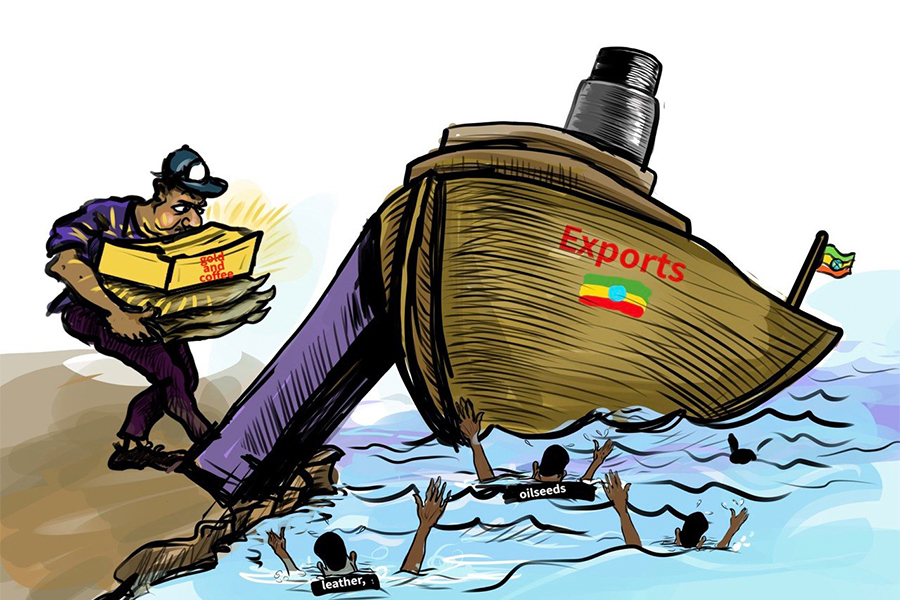
A record is a strange thing to worry about. Federal trade officials have booked the b...

Aug 14 , 2026
Aschalew Fetene, known as “Ardi” and admired for his poetic depth, has built a ti...

Aug 8 , 2026
The World Bank asks readers to picture a mother in rural Ethiopia who has never held...

Jul 31 , 2026
Weldu Yiheysh has not read the Pacific temperature charts. He does not need to. In Shibta District of Enderta Wereda, in...
Aug 22 , 2026 . By BEZAWIT HULUAGER
The forthcoming strategy for interest-free finance will place Sharia-compliant financ...
Aug 22 , 2026 . By NAHOM AYELE
Wegagen Capital Investment Bank (WCIB) has completed its first full year in profit an...
Judges at the Federal High Court, sitting on a limited basis to hear only urgent matt...
Aug 22 , 2026 . By BEZAWIT HULUAGER
Federal authorities are about to find out whether they can make a single payment wind...






 Loading your updates...