

Fortune News | Aug 08,2020



Jul 2 , 2026

Ethiopia has won another reprieve from the International Monetary Fund (IMF), yet the relief arrives at a moment that lays bare how fragile its recovery remains.
IMF’S Executive Board approved a fresh 464 million dollar disbursement on Wednesday, July 1, 2026, handing Prime Minister Abiy Ahmed's government near-term financial breathing space as a war-driven surge in imported fuel costs threatens to unsettle one of Africa's most ambitious economic reform programmes.
The Board completed the fifth review of the country's 48-month Extended Credit Facility (ECF), clearing the government to draw about 464 million dollars, and lifting total disbursements under the programme to 2.65 billion dollars since the arrangement was approved in July 2024.
However, the money is coming with unusual urgency. The Fund disclosed that it would bring forward about 200 million dollars, close to half of this week's tranche, to ease financing pressures tied to the war in the Middle East, which has pushed up the cost of fuel imports and complicated Ethiopia's effort to bring inflation under control after years of macroeconomic stress.
According to Nigel Clarke, the IMF deputy managing director and acting chair of the Board, that conflict represents "a significant external shock.” He warned that continued reform would be needed to sustain the country's momentum.
"The authorities continue to make progress in advancing their economic reform agenda, with favorable macroeconomic outcomes despite a challenging environment," Clarke said.
For Addis Abeba, the disbursement reads as a vote of confidence and a warning.
Ethiopia has stayed broadly on track, meeting all performance criteria and most indicative targets, according to the Fund, which cited strong exports, improved tax collection and rising reserves as signs that reforms are gaining traction. But the same statement made clear that the next phase will demand harder choices, from keeping monetary policy tight, deepening foreign-exchange liberalisation, and raising tax revenue to phasing out fuel subsidies, completing debt restructuring and strengthening Central Bank governance, all while shielding poorer households from the shock of higher prices.
The programme, backed by the Fund's concessional lending arm, is designed to unwind years of distortions that left Ethiopia with acute foreign-exchange shortages, weak reserves, high inflation, a narrow tax base and mounting debt-service pressures. It underpins the government's Homegrown Economic Reform Agenda, which seeks to move the economy toward private-sector-led growth after years of state-led investment and administrative control.
The Fund's projections made it apparent why it remains cautiously encouraged.
Real gross domestic product (GDP) growth is projected at 9.2pc in 2025/26 before easing to 7.8pc in 2026/27. Average inflation, which was 26.6pc in 2023/24, is projected to fall to 11.7pc in 2025/26, though it is expected to edge up to 12.3pc the following year as the fuel-price shock feeds through the economy.
However, this outlook leaves little room for complacency as the fuel shock threatens to lift transport and food costs in an economy where households have already endured years of pressure. The Fund's insistence on a tight position reveals a concern that temporary import-cost increases could harden into broader price pressures if expectations are not contained.
The Central Bank, according to the Fund, should hold policy tight to anchor those expectations and stand ready to tighten further if second-round effects emerge, while continuing to modernise its framework and nurture a more competitive and market-oriented financial sector.
For a country long starved of hard currency, the improvement in reserves matters, but it remains modest. Import cover is projected to rise from 0.7 months in 2023/24 to 2.1 months in 2025/26 and 2.7 months in 2026/27. By 2030/31, the Fund expects reserves to reach 3.8 months of imports, a level that would give the Central Bank more protection against external shocks yet still leave the economy exposed to swings in commodity prices, capital flows and the fuel bill driving the year's shock.
Government revenue is projected to climb from 7.3pc of GDP in 2023/24 to 10.8pc in 2025/26 and 11.4pc in 2026/27, reaching 12.3pc by 2030/31, a ratio that even at its projected peak would still capture barely more than one Birr in every eight of national output. That would mark a substantial lift in the administration’s tax effort, but it also means businesses and households are likely to stay under pressure from tighter enforcement and revenue-administration reform.
The IMF characterized the revenue performance as strong while insisting that prudent spending control remained essential, and it urged the government to phase out fuel subsidies while protecting vulnerable groups, arguing these would “free resources for development and social spending”
Foreign exchange remains one of the programme's most consequential fronts. IMF welcomed steps to ease some exchange restrictions, enforce net open foreign-exchange position limits, develop an interbank market and sharpen competition among banks. It also called for a plan for the Central Bank to improve its gold-market operations and eventually exit the market, provided the move stays consistent with reserve-accumulation goals.
Credit to the private sector and state-owned enterprises contracted by 9.7pc in 2024/25, according to Fund data, but is projected to jump by 55.9pc in 2025/26, a swing of more than 65 percentage points in a single year, before moderating to 24.8pc in 2026/27. Those projections include the impact of the Commercial Bank of Ethiopia's (CBE) recapitalisation, signalling the headline figure may reflect balance-sheet repair as much as a broad-based revival in lending.
Ethiopia defaulted on its Eurobond during the earlier phase of its debt crisis and has since worked with official and commercial creditors to restore sustainability. Several bilateral agreements have been signed with official creditors, significant progress has been made with several external commercial creditors, and an agreement-in-principle has been reached with Eurobond holders, according to the Fund, which nonetheless stopped short of declaring the process complete. It pressed Addis Abeba to maintain good-faith engagement, show prudence in contracting new debt, and build a liquid monetary market to reduce future vulnerabilities.
The debt path the IMF sketches is favourable, but it depends on execution. Public debt is estimated to have jumped from 35.5pc of GDP in 2023/24 to 50.5pc in 2024/25, a near 15-point leap in a single year, before falling to 45.3pc in 2025/26 and 40.8pc in 2026/27, declining to 28.6pc by 2030/31. External debt follows a similar arc, rising to 31.8pc of GDP in 2024/25 before easing to 16.7pc by 2030/31.
Fortune News | Aug 08,2020
Fortune News | May 11,2019
Verbatim | Mar 23,2019
Money Market Watch | Nov 09,2024

Editorial | Feb 16,2019
Radar | Sep 02,2023

Fortune News | Jan 22,2022
Radar | Feb 09,2019
Radar | Aug 21,2021
Commentaries | Sep 04,2021

Photo Gallery | 193404 Views | May 06,2019

Photo Gallery | 183294 Views | Apr 26,2019

Photo Gallery | 180106 Views | Oct 06,2021

My Opinion | 145530 Views | Aug 14,2021






Aug 14 , 2026
Aschalew Fetene, known as “Ardi” and admired for his poetic depth, has built a ti...

Aug 8 , 2026
The World Bank asks readers to picture a mother in rural Ethiopia who has never held...

Jul 31 , 2026
Weldu Yiheysh has not read the Pacific temperature charts. He does not need to. In Shibta District of Enderta Wereda, in...
Jul 25 , 2026
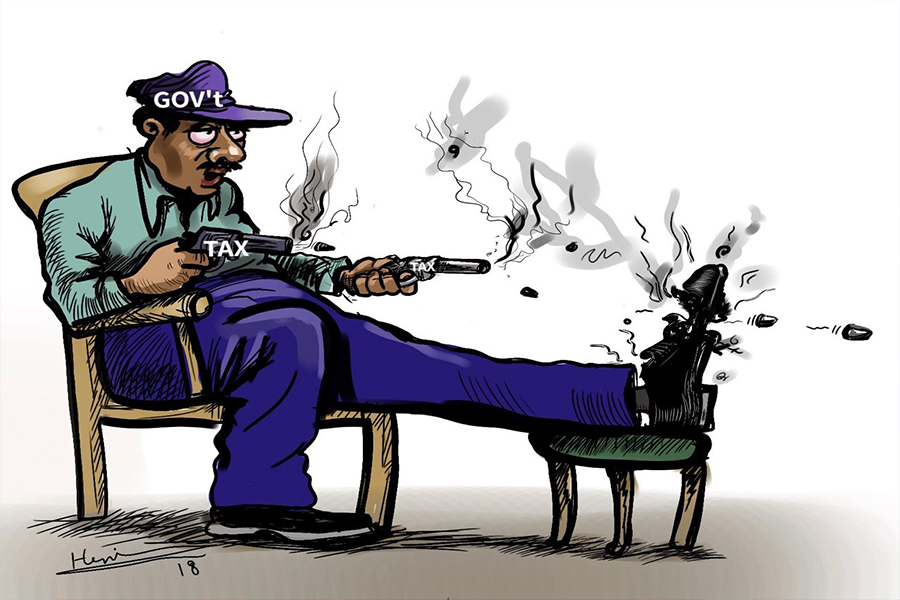
Ideally, citizens who have paid income tax all year should not have to reach for thei...






 Loading your updates...