


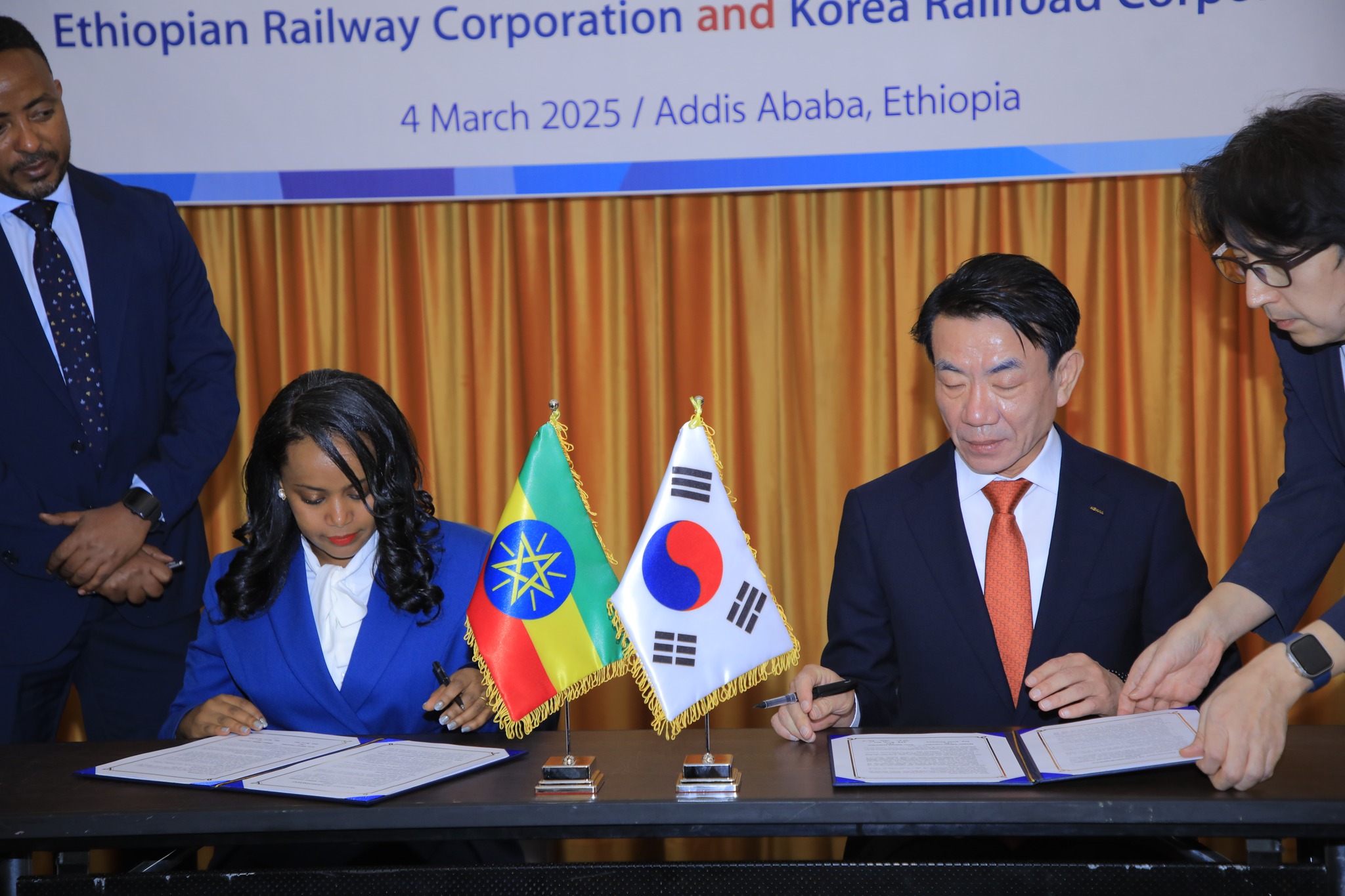
The Ethiopian Railways Corporation (ERC) and Korea Railroad Corporation (KORAIL) have signed a Memorandum of Understanding (MOU) to advance railway development, technical exchange, and infrastructure modernization in Ethiopia. The agreement includes the creation of technical training programmes and advisory services aimed at aligning Ethiopia’s railway systems with international standards. The MOU focuses on four main areas: technical exchange, operational and maintenance advisory services, infrastructure development, and standardization and technical education. The agreement paves the way for new railway construction projects, feasibility studies, and the establishment of a Korea-Ethiopia Railway Working Group to facilitate collaboration. KORAIL’s President, Han Moon-Hee, emphasized the strong historical ties between Ethiopia and Korea, reaffirming Korea’s commitment to supporting Ethiopia’s railway ambitions. As one of Korea’s key Official Development Assistance (ODA) partners, Ethiopia will also be exploring financing opportunities for future railway projects. Hilina Belachew, CEO of Ethiopian Railway, said the MOU marks a new era of collaboration between the two railways, an era built on mutual trust, shared expertise, and a common vision for the advancement of the railway sector. According to the MOU, the collaboration is expected to improve railway connectivity, enhance logistic efficiency, and promote sustainable economic growth, positioning Ethiopia as a regional hub for modern rail transport. Both nations have expressed their dedication to ensuring the successful implementation of this partnership for mutual benefit. Sileshi Kassa, deputy CEO of Ethiopian Railway and Head of the Railway Infrastructure Development Division noted that a key aspect of the agreement is capacity building, particularly in the areas of studying and operating both existing and new railway lines. Previously, Ethiopia relied solely on the government to manage railway operations, but this agreement seeks to address that challenge by leveraging international expertise. The collaboration will not only help operationalise existing projects but also support the development of new railway initiatives. Ethiopia aims to establish railway lines along various routes to transport resources that cannot be moved efficiently by road. Ethiopian Railways is hopeful that KORAIL will lend its expertise to ongoing studies with the Kenyan government on utilising the Lamu Port. The possibility of constructing a railway line in Sudan has also been met with positive sentiment.
[ssba-buttons]
 Loading your updates...