


Mar 30 , 2019
By Getaneh Abera
April 2, World Autism Awareness Day, aims to put a spotlight on the hurdles that people with autism and their families face every day. Western countries have put in a great deal of research on this developmental disorder, raising awareness, service provisions and policy formulations.
Awareness about the disorder is showing improvement in Ethiopia, but there remains much that is still unknown and misunderstood. The number of children who are diagnosed with autism is estimated to be increasing, but the amount of dedicated health providers remains constant.
No specific policy considers autism as a specific case. We are in a country where psychological and developmental disorders do not carry as much currency in the medical profession, and special needs education has barely gotten off the ground.
Worse still, autism has not broken through social barriers and continues to be attached to myths that are making addressing the problem more challenging.
One of the most widespread beliefs is that the symptoms of the disorder have a spiritual cause. What is usually recommended, out of desperation as well as awareness by parents, are spiritual interventions. Hospitals usually are not the first choice for treatment for someone with a mental health problem, especially in rural areas.
Some research shows that faith has a positive influence on people’s mental states, but the view that an evil spirit causes autism is dangerous. It causes stigma and discrimination, even by parents, and the methods used to rid oneself of this social as well as mental problem can potentially worsen the condition of the children.
Another harmful myth about autism is that it is transmittable, leading to further discrimination and marginalisation of those affected by it. That autism is contagious, like the flu, is a surprisingly common theory in religious places and schools.
“It is not my son being autistic that hurts me,” a mother once told me. “In case my son and I pass by the field where children are playing, they run away like they have seen a wild animal. I know they don’t feel this way; it is their parents who tell them that it is transmittable.”
The causes of autism, which affects millions of people around the world, are more genetic or associated with environmental factors. This simple awareness can go a long way in getting communities to pitch in to address this problem.
Just as frustrating a myth associated with the disorder is that of aggressiveness. Autistic children do not deliberately attack their peers or anyone else. They do not seriously think about how to hurt or attack someone. But they could be easily manipulated into doing this.
Otherwise, aggression may happen due to sensory overload or the frustration from their inability to communicate or express themselves. This myth is common in schools and with teachers.
This comes from a lack of understanding of the children’s conditions and special needs. There are multiple examples of how nonverbal and “aggressive” children that were sent to autism centres showed incredible progress in both communication and academics by the time they were promoted to mainstream schools.
What is harmful is expecting children with this disorder to act and show the same level of social communication skills that kids without autism have. Under the right treatment packages and proper awareness of the behaviour patterns of these children, there are chances of bringing them up to speed.
Without a national policy and a community to contribute its fair share in helping these children and their parents though, the problem will persist, and early recognition and treatment possibilities will dissipate.
PUBLISHED ON
Mar 30,2019 [ VOL
19 , NO
987]


Viewpoints | Feb 16,2019

Radar | Dec 19,2021
Fortune News | Jun 14,2020
Money Market Watch | Apr 19,2026
Verbatim | Mar 02,2019

Fortune News | Nov 16,2019

Sunday with Eden | Aug 17,2019
Covid-19 | Mar 14,2020
Commentaries | Jun 18,2022
Commentaries | Jul 10,2020

Photo Gallery | 190779 Views | May 06,2019

Photo Gallery | 180538 Views | Apr 26,2019

Photo Gallery | 177208 Views | Oct 06,2021

My Opinion | 142893 Views | Aug 14,2021








Dec 22 , 2024 . By TIZITA SHEWAFERAW
Charged with transforming colossal state-owned enterprises into modern and competitiv...

Aug 18 , 2024 . By AKSAH ITALO
Although predictable Yonas Zerihun's job in the ride-hailing service is not immune to...

Jul 28 , 2024 . By TIZITA SHEWAFERAW
Unhabitual, perhaps too many, Samuel Gebreyohannes, 38, used to occasionally enjoy a couple of beers at breakfast. However, he recently swit...

Jul 13 , 2024 . By AKSAH ITALO
Investors who rely on tractors, trucks, and field vehicles for commuting, transporting commodities, and f...
Jul 4 , 2026
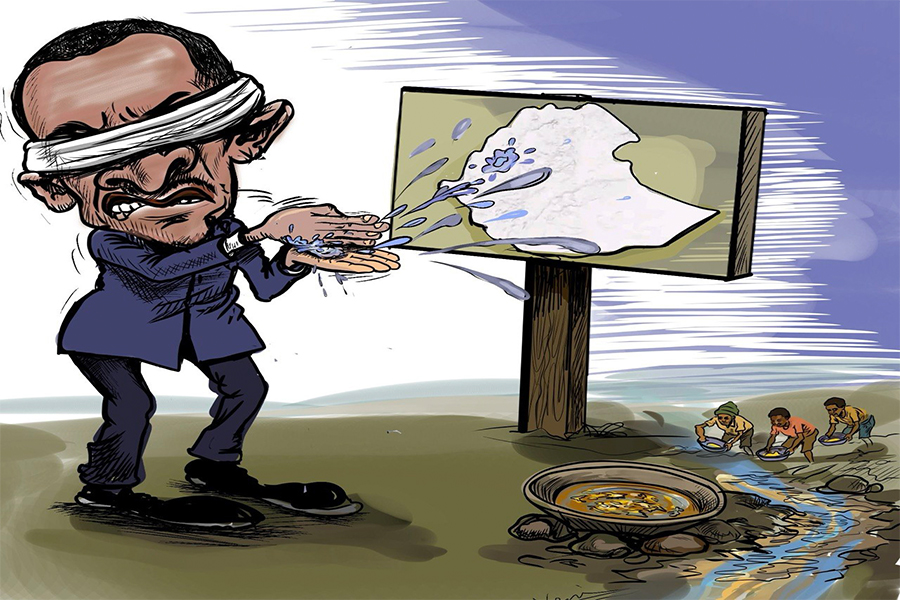
In the goldfields of the Benishangul-Gumuz Regional State, Ethiopia's balance-of-paym...

Jun 27 , 2026
The federal legislative house rushed through one of the country's most contentious ho...
When Parliament takes up the appropriation bill, federal legislators will receive a d...
Jun 13 , 2026
The recent policy decision to fully open freight forwarding to foreign capital may be...
Jul 7 , 2026
The health sector remains underprovided despite rising public spending, Prime Ministe...
Jul 7 , 2026
Prime Minister Abiy Ahmed (PhD) delivered one of his bluntest rebukes yet to the coun...
Jul 7 , 2026
Prime Minister Abiy answered his critics with a mix of gratitude and edge, thanking l...

Jul 7 , 2026
A ruling-party lawmaker, Mohammed Ahmed, called the Chamber to its feet for Prime Min...







 Loading your updates...