
Commentaries | Sep 10,2023



Oct 26 , 2024
By Ngozi Okonjo-Iweala , Makhtar Diop
The supply chain forms the skeleton of global trade, accounting for over half of global merchandise trade value. In this commentary provided by Project Syndicate (PS), Ngozi Okonjo-Iweala, director-general of the World Trade Organization (WTO), and Makhtar Diop, managing director of the International Finance Corporation (IFC), argue that the finance undergirding these vast networks is falling short, leaving many small businesses in developing countries unable to fully participate in the global economy.
Supply chains form the backbone of international commerce, representing over half the value of global merchandise trade. They also create large numbers of jobs and lower the bar for countries and companies to participate in the world economy. But, the finance underpinning supply chains is inadequate, leaving too many small businesses in emerging and developing economies cut off from the benefits of global trade.
Supply-chain networks bring together raw materials, parts, services, and other inputs from multiple countries, with goods often crossing borders several times for processing before they are finished, distributed, and marketed. The firms within these networks depend on short-term supply-chain finance to avoid being squeezed between upfront payments to their suppliers and late payments by their buyers. Such financing enables a large share of global trade, and for small firms in developing countries, it is essential.
Supply-chain finance was a lifeline for many during the COVID-19 pandemic, which disrupted trade and markets globally. As consumers worldwide shifted spending from entertainment and travel to goods, businesses in industries vital for developing countries faced cashflow constraints, owing to the surge in demand and production. Garment producers, for example, needed financing to increase their purchases of inputs, even though payments from buyers would come only later. Supply-chain finance offered access to immediate funds, helping them manage working capital, stabilise operations, and contribute to easing the world's supply bottlenecks.
At the global level, supply-chain finance is one of the fastest-growing segments of trade finance, with BCR's World Supply Chain Finance Report 2024 estimating its value at around 2.3 trillion dollars. But, only some are benefiting from this expansion. While large multinational corporations and developed economies have seamlessly integrated supply-chain finance into their procurement networks, most businesses in developing countries remain on the sidelines.
For these firms – most of which are micro, small, and medium-sized enterprises (MSMEs) – securing supply-chain finance from local banks is a significant challenge, owing to weak legal frameworks, inadequate technological infrastructure, and prohibitively high costs. This limits many firms' ability to grow and thrive, and their countries cannot reap the full benefits of global trade.
Data from joint trade-finance surveys conducted by the International Finance Corporation (IFC) and the World Trade Organisation (WTO) illustrate the extent of the problem. Even in countries like Vietnam and Cambodia – where many small firms have managed to tap into supply chains in sectors like textiles and consumer electronics despite operating primarily on a cash basis – shortages of supply-chain finance are causing economic harm.
Although 50pc of these countries' trade is supply chain related, only 0.5pc of their trade is supported by supply chain finance from local financial institutions. As a result, local firms not only face constant financial pressure and higher exit rates; they also are unable to generate the investment resources that are so important for moving up the value chain.
The benefits that would come from increasing supply chain finance in developing economies are substantial. WTO research shows that a 10pc increase in the use of international factoring (the main type of supply chain finance, used primarily by MSMEs to secure immediate cash against their unpaid outstanding invoices) can boost countries' trade by one percent. Expanding access to supply chain finance tools also could significantly increase participation in trade, especially by MSMEs in developing countries. And that, in turn, would help raise incomes, reduce poverty, and foster greater financial inclusion.
For their part, multilateral development banks can do much more to catalyse supply-chain finance in developing countries. We propose that multilateral lenders commit to coordinating their efforts with governments, industry associations, and local and international financial institutions. Such collaboration could advance multiple objectives.
It could strengthen the legal frameworks for supply chain finance where they are weak or nonexistent, as well as build greater capacity among regulators and policymakers. International organisations can also help standardise credit data reporting, solvency rules, and enforcement mechanisms by training market participants and regulators in global best practices. They can promote digitalisation by supporting the development of essential technological infrastructure. And finally, they can provide financing and technical assistance to banks and other providers of supply chain finance in emerging markets, which will increase product availability.
By working together, multilateral organisations, governments, and financial institutions can unlock the full potential of supply chain finance, thus promoting trade and financial inclusion in the world's most underserved regions. When it comes to driving development, increasing supply chain finance is a low-hanging fruit. Given its significant potential to deliver gains for employment, trade, and growth, plucking it could advance a broad range of global development objectives.
PUBLISHED ON
Oct 26,2024 [ VOL
25 , NO
1278]
Commentaries | Sep 10,2023

Fortune News | May 17,2025
Commentaries | Jun 13,2026

Fortune News | Apr 26,2025

Fortune News | Feb 01,2020

Commentaries | Feb 21,2026
Radar | May 12,2024

Fortune News | Nov 24, 2024
Fortune News | Aug 31,2020
Money Market Watch | Dec 13,2025

Photo Gallery | 190620 Views | May 06,2019

Photo Gallery | 180361 Views | Apr 26,2019

Photo Gallery | 177038 Views | Oct 06,2021

My Opinion | 142744 Views | Aug 14,2021






Dec 22 , 2024 . By TIZITA SHEWAFERAW
Charged with transforming colossal state-owned enterprises into modern and competitiv...

Aug 18 , 2024 . By AKSAH ITALO
Although predictable Yonas Zerihun's job in the ride-hailing service is not immune to...

Jul 28 , 2024 . By TIZITA SHEWAFERAW
Unhabitual, perhaps too many, Samuel Gebreyohannes, 38, used to occasionally enjoy a couple of beers at breakfast. However, he recently swit...

Jul 13 , 2024 . By AKSAH ITALO
Investors who rely on tractors, trucks, and field vehicles for commuting, transporting commodities, and f...
Jul 4 , 2026
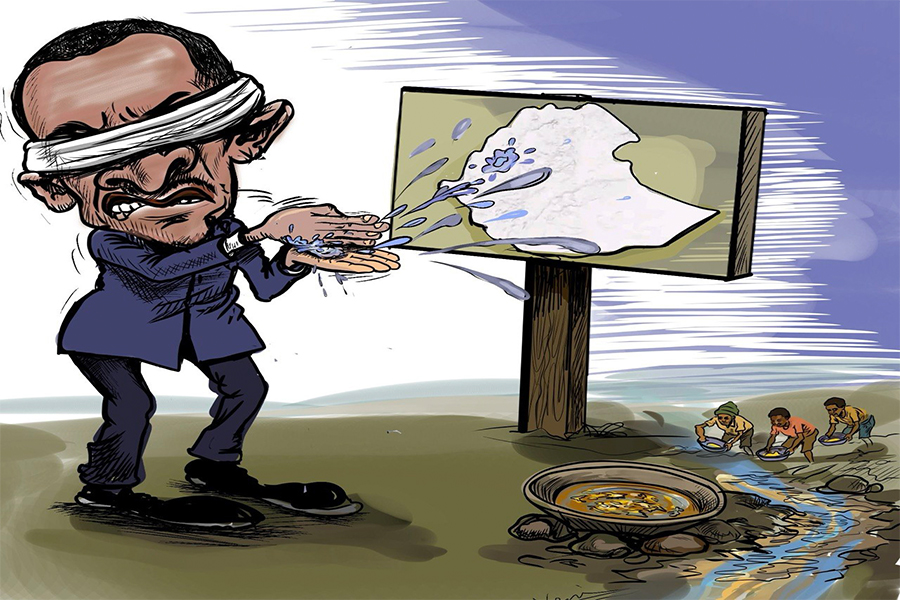
In the goldfields of the Benishangul-Gumuz Regional State, Ethiopia's balance-of-paym...
Jun 27 , 2026
The federal legislative house rushed through one of the country's most contentious ho...

When Parliament takes up the appropriation bill, federal legislators will receive a d...
Jun 13 , 2026
The recent policy decision to fully open freight forwarding to foreign capital may be...
Jul 4 , 2026
Addis Abeba's renters and property owners are waiting on a city government decision that will set how far rents can rise...
Jul 4 , 2026 . By BEZAWIT HULUAGER
The Ethiopian Airlines Group is preparing to place a firm order for 25 aircraft next...
Jul 4 , 2026 . By BEZAWIT HULUAGER
Ethio telecom's shares have climbed to 852 Br in secondary over-the-counter trading,...

Jul 4 , 2026 . By NAHOM AYELE
A lawsuit at the federal courts has turned a quiet quarrel between one of the country...







 Loading your updates...