


Feb 27 , 2021
By Eden Sahle
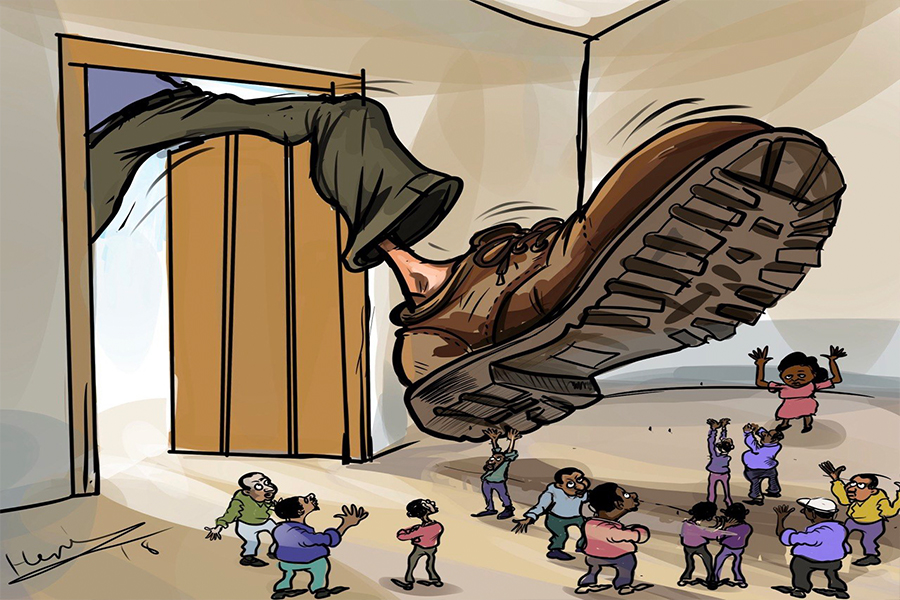
The way people are talking about the upcoming general election, which will be held on June, 2021, is troubling. Many have concluded that elections combined with the African political culture are more sources for violence than social cohesion.
There is some truth to this. Often, African elections are conducted on an uneven playing field, where the incumbents can take significant advantage of their position in power, especially in terms of access to the media. One reason discouraging many in our country is that some major opposition figures are currently in jail.
Still, elections are crucial rights of citizens. It offers them a voice by enabling them to select leaders and hold them accountable for their performance in office. Alas, these facts do not hold water for many who are in great fear of the violence the election may bring.
This is not helped by some political players. Instead of discussing policies, strategies and attempting to heal social wounds, parties are busy criticising each other over logos and slogans. The dominant public discourse and the language and terminology used by most political parties are associated with armed struggle. This has convinced many that elections in Africa are modern day battlegrounds. Ethiopia is no exception to this.
The dangers linked with electoral violence vary. On top of human, material and economic costs that such violence imposes on already impoverished nations, it also risks undermining the electoral legitimacy of the process. This stems from the weak political culture that exists, where opponents do not merely argue and compete to win hearts and minds. They actively try to discredit each other without telling us much about what they will do in office if elected.
Election seasons should instead be a cause for excitement since it is the most important institutional mechanism for distributing political power and a time for people’s voices to be heard. But the significance of this is compounded by people’s judgments about the willingness to vote, support for democracy and trust in governing institutions. Such things do not just come by but are reflections of everyday politics in a politically divided society.
Unhealthy competitive elections are by their nature the result of conflict due to the public's divergent interests that go too deep as to create intolerance. Thus, there is always a risk that an electoral race will contribute to intensifying and polarising existing socioeconomic problems, provoking further divisions in society if ample care is not taken.
One key reason for electoral violence has to do with elections organised along exclusive political ideologies. It created structural conditions for political elites to utilise an electoral strategy based on narratives that exclude wide sections of the populations. It subverts and distorts the significance of multiparty democracy, where political groups disagree and engage with ideas. When they do so along the lines of identity, it becomes hard to hear one another.
In societies such as ours, where the structural conditions of elections create significant incentives for violence, the institutional and administrative arrangements for regulating the contest can play a vital role.
The electoral system has to influence the efficacy, transparency and political integrity of the elections, eliminating election fraud and manipulation, and creating voter and political parties' trust over elections and its processes. This is just as much the job of democratic institutions such as the police and public media as it is the National Electoral Board of Ethiopia (NEBE). Another critical player is the court system, which can handle disputes fairly.
But in the absence of credible democratic institutions that adhere to the rule of law and prove their political independence, there is always the risk that the election would be ignored, its significance weakened, and the outcome not accepted by losing political contenders.
Political parties should indeed make it their campaign agenda to encourage voters to trust the electoral system, vote on polling day, and accept the results even if the party they support is not victorious. Indeed, this is an effort that should be preceded by those in political power proving to the public that their intention is for free and fair elections to take place.
Eden Sahle is founder and CEO of Yada Technology Plc. She has studied law with a focus on international economic law. She can be reached at edensah2000@gmail.com.
PUBLISHED ON
Feb 27,2021 [ VOL
21 , NO
1087]

Editorial | Oct 05,2019

Election 2026 coverage | Nov 22,2025
Sunday with Eden | Oct 16,2020
Agenda | May 08,2021

Fortune News | May 29,2021

My Opinion | Jun 27,2020
My Opinion | Jun 20,2020
Radar | Mar 16,2019
Verbatim | Nov 14,2020
Money Market Watch | Aug 30,2025

Photo Gallery | 190779 Views | May 06,2019

Photo Gallery | 180538 Views | Apr 26,2019

Photo Gallery | 177208 Views | Oct 06,2021

My Opinion | 142893 Views | Aug 14,2021




Dec 22 , 2024 . By TIZITA SHEWAFERAW
Charged with transforming colossal state-owned enterprises into modern and competitiv...

Aug 18 , 2024 . By AKSAH ITALO
Although predictable Yonas Zerihun's job in the ride-hailing service is not immune to...

Jul 28 , 2024 . By TIZITA SHEWAFERAW
Unhabitual, perhaps too many, Samuel Gebreyohannes, 38, used to occasionally enjoy a couple of beers at breakfast. However, he recently swit...

Jul 13 , 2024 . By AKSAH ITALO
Investors who rely on tractors, trucks, and field vehicles for commuting, transporting commodities, and f...
Jul 4 , 2026
In the goldfields of the Benishangul-Gumuz Regional State, Ethiopia's balance-of-paym...
Jun 27 , 2026
The federal legislative house rushed through one of the country's most contentious ho...
When Parliament takes up the appropriation bill, federal legislators will receive a d...
Jun 13 , 2026
The recent policy decision to fully open freight forwarding to foreign capital may be...
Jul 7 , 2026
The health sector remains underprovided despite rising public spending, Prime Ministe...
Jul 7 , 2026
Prime Minister Abiy Ahmed (PhD) delivered one of his bluntest rebukes yet to the coun...
Jul 7 , 2026
Prime Minister Abiy answered his critics with a mix of gratitude and edge, thanking l...
Jul 7 , 2026
A ruling-party lawmaker, Mohammed Ahmed, called the Chamber to its feet for Prime Min...








 Loading your updates...