Photo Gallery | 185861 Views | May 06,2019
May 9 , 2026. By NAHOM AYELE ( FORTUNE STAFF WRITER )
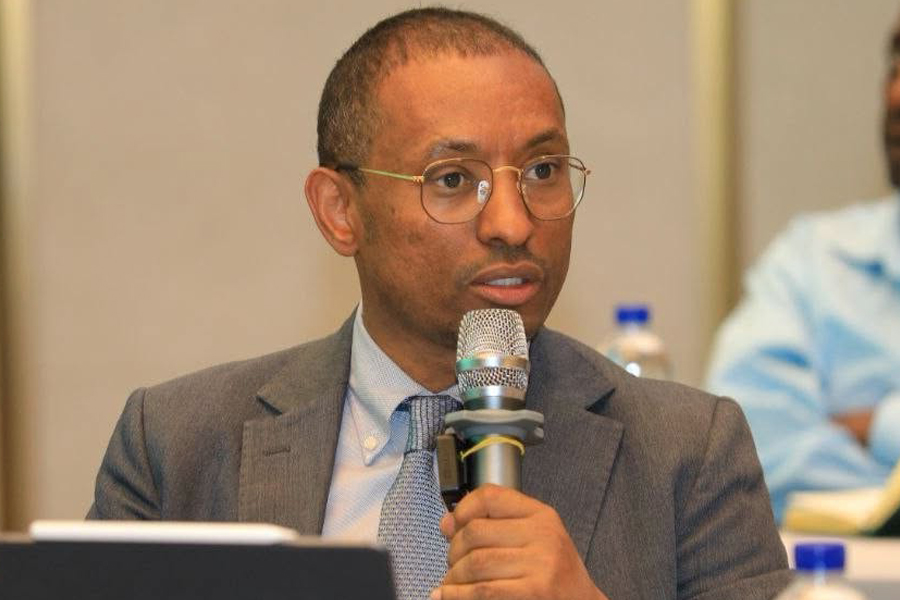
Minister Abraham Belay (PhD) stood before Parliament to defend a performance that showed the Ministry of Irrigation & Lowlands had nearly emptied its coffers by April. With 98pc of the annual budget spent in three quarters, the Ministry faced a blunt probe into how the capital was deployed, even as many projects remain invisible to the public. The hearing transformed a routine hearing into a rigorous cross-examination by 12 MPs over the gap between fiscal execution and tangible results.
Abraham Belay (PhD), minister of Irrigation & Lowlands (MoIL), and his senior officials appeared before Parliament last week with the awkward balance sheet of a federal agency that had nearly exhausted its purse before many of its projects could be seen on the ground.
In nine months, the Ministry, headquartered off the Tito Road in the Casanchis neighbourhood, had used 98pc of its annual budget. Yet, several irrigation schemes remained delayed, underperforming, or suspended due to security disruptions. For federal lawmakers, the Minister's report raised a blunt question.
How could almost all the money be spent when too much of the work appeared unfinished?
According to data from the Ministry of Finance, a capital budget of 17.1 billion Br was allocated to large-, medium-, and small-scale irrigation projects (including external financing)in the 2025/26 budget year. This represents 4.1pc of the 415 billion Br total capital expenditure budget and 0.9pc of the total federal budget of 1.93 trillion Br. Federal legislators pressed Minister Abraham on Thursday, April 23, 2026, turning a routine hearing into an interrogation over budget discipline, project delivery and the gap between reported execution and visible progress. No fewer than 12 MPs challenged the Minister over delayed schemes, stalled works, and the absence of new projects in their respective constituencies.
Abraham, who has led the Ministry since May 2024, replaced Aisha Mohammed after a cabinet reshuffle that moved him from the Ministry of Defence to his current Ministry and sent Aisha to the Ministry of Defence. Mandated to study, develop and supervise irrigation projects, including design work and implementation oversight, the Ministry is working on 12 large and medium-sized projects in the design phase and 19 irrigation projects under construction.
Minister Abraham disclosed that nine of the 19 construction projects were fully completed during the first nine months. The completed projects, including Walmel, Chelchel, Gidabo, West Gode, Qeto and Dubti Dyke, have brought about 59,000hct of land into productive agricultural use.
Other schemes remain unfinished, including the Megech Irrigation Development Project, Arjo Dedesa, Khalid Dijo, Ajima Chacha, Logiya, and Adea Becho, all of which are still under construction. The Minister conceded that the Upper Rib, Fantale, and Upper Guder irrigation development projects have been delayed or suspended due to security-related challenges.
Abreham appeared uneasy as MPs pressed him, while he kept taking notes. Legislators demanded to know why projects in Oromia, Amhara, South, Central, and South West Ethiopia regional states were not completed on schedule, and why new projects had not started in their constituencies despite what they described as available capacity. While opposition MPs attending the hearing were observed to be muted, all the questions were fired by MPs representing the ruling Prosperity Party (PP), who focused on execution, financing, and the scheduled delivery of projects.
The Standing Committee member, Mesfin Dagne (MP-PP), fired off questions, focusing on financial management, overpayments, underpayments to contractors, and gaps between planned activities, budget use, and implementation.
Alemu Gonfa (PhD), an MP-PP, directly challenged the figures reported by the Minister. He pointed out that the Ministry had used almost its full budget within nine months, while many projects were stalled or not operating.
“Almost 100pc of the budget has been used, but many projects aren't functioning," he probed the Minister. "Why is that?”
Alemu also asked whether the Ministry had received less money than it needed or had released advance payments beyond planned allocations. He pressed Abraham to explain how his Ministry would complete the remaining projects with only a small portion of the approved budget remaining.
Bizuayehu Degefa (PhD), another MP-PP, raised concern over the Ministry’s reported 96pc plan execution. He demanded to know how such a high implementation rate could be justified when several projects were delayed or in trouble.
“On what basis was the 96pc calculated for execution when most projects are struggling?” Bizuayehu asked.
Abraham, a close ally of Prime Minister Abiy Ahmed (PhD) from their years at the Information Network Security Agency (INSA), defended his Ministry’s record. He has held board roles at the Ethiopian Roads Authority (ERA), the Commercial Bank of Ethiopia (CBE), and the Ethiopian Electric Power (EEP). He told lawmakers that many questions reflected concern over the absence of new irrigation projects in their constituencies. Since taking office, his Ministry has not launched new schemes but rather focused on completing ongoing and delayed projects.
“We aren't starting new projects this year," he told Parliament. "We're focusing on what we already have in hand.”
The Minister defended the budget utilisation rate, blaming the financing gap and claiming that actual implementation requirements were closer to 50 billion Br.
“We didn't receive sufficient budget to execute our plan fully,” he said.
According to Abraham, the shortage of funds had constrained the Ministry’s targets, but it could achieve them if it secured the required financing.
“We used 98pc of the budget, but that does not mean we're now at zero," he said with a tone of reassurance. "We also have funds from partners.”
Nonetheless, his explanation did not seem to settle all doubts. It clarified that the Ministry bases the spending rate on the approved allocation, not its projected needs, but left unanswered how much partner financing has been available and disbursed, and how the reported execution rate was calculated, given that security, slowed construction, and weak functionality remain in the same portfolio.
For Biniyam Yaziz, a researcher and irrigation expert at the Ethiopian Institute of Agricultural Research (EIAR), budget constraints explain only part of the Ministry’s ordeals. Agriculture is often given priority in policy language, but the budget does not match that ambition.
“Even though the government says it prioritises agriculture, the budget allocated is not sufficient to support effective implementation,” he said.
According to Biniyam, deeper problems lie in project management. He pointed to poorly studied projects, weak feasibility assessments and design flaws that begin before construction. Some projects, he said, are implemented mainly to satisfy regional allocation targets rather than be technically ready. He also raised concerns about contractor selection, noting that some irrigation projects are awarded to firms with insufficient experience or competence in irrigation infrastructure development.
"Community engagement is another weakness, with limited local ownership in protecting and sustaining projects," Biniyam told Fortune.
Security disruptions in project areas have compounded delays. For Biniyam, Ethiopia’s food self-sufficiency ambitions depend on shifting away from reliance on rain-fed agriculture and enabling two to three harvest cycles a year. With adequate budget, stronger project management, and community ownership, he hopes that irrigation could reduce dependence on rainfall and deliver national gains.
The Standing Committee Chairwoman, Fetia Ahmed, closed the session with a caution. The Ministry, she said, should maintain its positive achievements while contending with its shortcomings.
Last week's Parliamentary hearing left Abraham with little comfort. He remains in charge of a Ministry that claims to have spent nearly all of its approved budget, completed nine projects, and opened about tens of thousands of hectares to production, but still has to prove that the accounting matches water, land, and harvests.
PUBLISHED ON
May 09,2026 [ VOL
27 , NO
1356]
Photo Gallery | 185861 Views | May 06,2019
Photo Gallery | 175902 Views | Apr 26,2019
Photo Gallery | 171462 Views | Oct 06,2021
My Opinion | 139414 Views | Aug 14,2021
May 9 , 2026
The Ethiopian state appears to have discovered a fiscal instrument that is politicall...
May 2 , 2026
By the time Ethiopia's National Dialogue Commission (ENDC) reached the end of its fir...
Apr 25 , 2026
In a political community, official speeches show what governments want their citizens...
For much of the past three decades, Ethiopia occupied a familiar place in the Western...