
Fortune News | Aug 01,2026



Aug 2 , 2025
By Aminu Nuru
The financial sector underwent a decisive shift this year following the National Bank of Ethiopia's (NBE) issuance of a new licensing and supervision framework for investment banks. Within weeks, CBE Capital staked its claim as the country’s first licensed investment bank, with Wegagen Capital and Awash Investment Bank hot on its heels.
Although the directive (980/2024) demonstrated regulators' broader push toward economic reform and market liberalisation, globally, it is common for conventional banks to house investment-banking arms as subsidiaries. In markets with mature oversight, these setups can diversify revenue streams, spur cross-selling opportunities and streamline resource use by sharing back-office infrastructure and market data. They also tend to strengthen local capital markets, channelling domestic expertise and liquidity into equity and debt offerings.
The advent of licensed investment banks holds promise for Ethiopia. Properly managed, these institutions could mobilise domestic savings, support corporate expansion and promote a vibrant capital market that attracts foreign investment. But the path to that outcome will require vigilance, institutional rigour and a willingness to learn from international best practices.
In Ethiopia’s still-nascent and fragile financial system, the balance of benefits and risks tips uneasily. The possibility of conflicts of interest looms large when a commercial bank parent and its investment bank offshoot operate under shared leadership. Regulators require limited companies to post a minimum capital of 25 million Br and subsidiaries to post a minimum capital of 100 million Br. In the case of the first, the amount would not buy a three-bedroom apartment in downtown Addis Abeba, let alone underwrite multi-million-dollar transactions.
The disparity should raise questions about whether these fledgling institutions can handle the complexity of mergers and acquisitions (M&A), public offerings, private placements and securities trading.
The earliest test of the investment banking will take place on the Ethiopian Securities Exchange (ESX), where initial listings are slated to feature banks and insurers. Ties between underwriting units and their commercial-bank parents are heavy, threatening to muddy advisory services. If Wegagen Bank board members double as directors at Wegagen Capital, impartiality becomes a luxury. Chinese walls, intended to segregate deal teams from deposit-gathering units, often exist more on paper than in practice, undercutting investor confidence.
The possibility of conflicts of interest looms large when a commercial bank parent and its investment bank offshoot operate under shared leadership.
Soon, M&A activity is expected to spike as consolidation pressures reshape the banking industry. Yet, borrowers and target companies may hesitate to divulge confidential material to an investment-bank affiliate of a potential suitor, curtailing deal flow or inflating due diligence costs. In jurisdictions where regulatory frameworks are still finding their footing, this tension has derailed transactions and precipitated outsized losses.
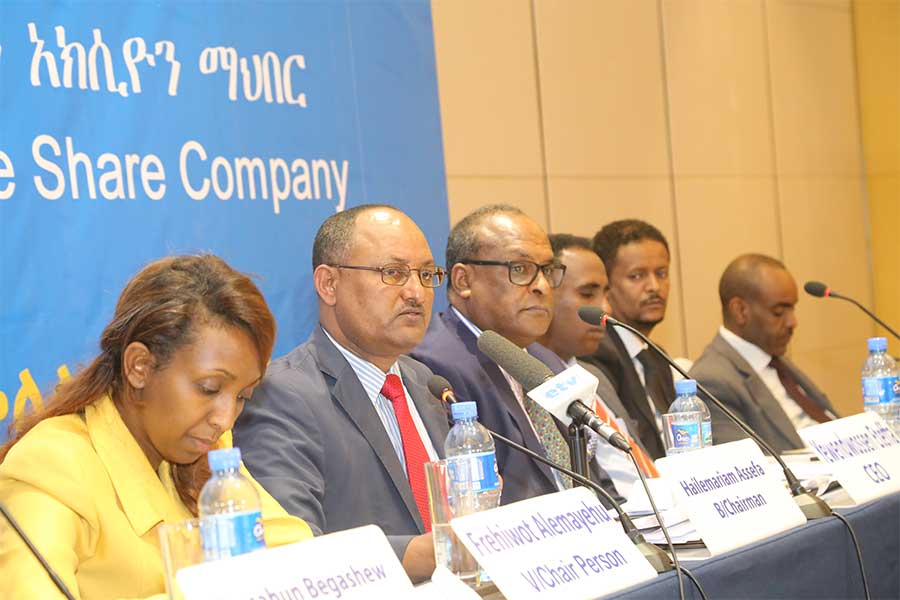
Governance overlaps deepen the dilemma. The President of the Commercial Bank of Ethiopia (CBE) also chairs CBE Capital’s board. The Vice Chairperson of Wegagen Capital serves as Wegagen Bank’s board chairperson. Such dual roles could erode the operational independence that investors and clients demand when a bank lends to a corporate shareholder and concurrently underwrites its initial public offering, the risk of insider trading and market manipulation increases, weakening the public trust that underpins every stable banking system.
Banks often count major companies among their shareholders, causing ethical concerns about client concentration. The pressure to list these firms on the ESX, while the same banks stand to profit from underwriting fees, potentially creates a conflict of interest. If those listings falter or fail, the fallout could spill over into the parent banks, shaking depositor confidence and, in a worst-case scenario, precipitating broader financial instability.
Reputational risk, in this context, should be as alarming as capital adequacy. A botched initial public offering (IPO), or an underwriting that misprices risk, could lead to headline news, and not the kind regulators or bank executives would welcome.
Recent history from other emerging markets shows that poorly managed investment-banking operations can amplify systemic vulnerabilities rather than alleviate them.
Bank board directors and senior executives should cultivate genuine operational autonomy for their investment-bank subsidiaries. Separating governance boards, distinct executive teams, and a clear firebreak between commercial and advisory units are some of the precautions they can consider. Hiring seasoned professionals, those who have structured deals and managed risk in established markets, will be crucial.
Regulators, for their part, should move beyond issuing directives on paper and ensure that Chinese walls are enforced in spirit as well as in text. Officials from the Ethiopian Capital Market Authority (ECMA) and the NBE should team up on joint inspections and shared reporting channels. They should also study the experiences of developing economies where weak oversight allowed investment-banking ventures to collapse under the weight of undisclosed conflicts of interest and overextension.
PUBLISHED ON
Aug 02,2025 [ VOL
26 , NO
1318]
Fortune News | Aug 01,2026
Fortune News | Oct 11,2020
Radar | Mar 25,2023
Fortune News | Dec 10,2022
Fortune News | Jun 29,2025
Fortune News | Oct 14,2023
Fortune News | Dec 28,2019
Radar | Sep 10,2022
Fortune News | Mar 16,2019

Radar | Oct 18,2025

Photo Gallery | 193573 Views | May 06,2019

Photo Gallery | 183467 Views | Apr 26,2019

Photo Gallery | 180292 Views | Oct 06,2021

My Opinion | 145717 Views | Aug 14,2021






Dec 22 , 2024 . By TIZITA SHEWAFERAW
Charged with transforming colossal state-owned enterprises into modern and competitiv...

Aug 18 , 2024 . By AKSAH ITALO
Although predictable Yonas Zerihun's job in the ride-hailing service is not immune to...

Jul 28 , 2024 . By TIZITA SHEWAFERAW
Unhabitual, perhaps too many, Samuel Gebreyohannes, 38, used to occasionally enjoy a couple of beers at breakfast. However, he recently swit...

Jul 13 , 2024 . By AKSAH ITALO
Investors who rely on tractors, trucks, and field vehicles for commuting, transporting commodities, and f...
Aug 22 , 2026
A record is a strange thing to worry about. Federal trade officials have booked the b...

Aug 14 , 2026
Aschalew Fetene, known as “Ardi” and admired for his poetic depth, has built a ti...

Aug 8 , 2026
The World Bank asks readers to picture a mother in rural Ethiopia who has never held...

Jul 31 , 2026
Weldu Yiheysh has not read the Pacific temperature charts. He does not need to. In Shibta District of Enderta Wereda, in...
Aug 22 , 2026 . By BEZAWIT HULUAGER
The forthcoming strategy for interest-free finance will place Sharia-compliant financ...
Aug 22 , 2026 . By NAHOM AYELE
Wegagen Capital Investment Bank (WCIB) has completed its first full year in profit an...
Aug 22 , 2026 . By NAHOM AYELE
Judges at the Federal High Court, sitting on a limited basis to hear only urgent matt...
Aug 22 , 2026 . By BEZAWIT HULUAGER
Federal authorities are about to find out whether they can make a single payment wind...






 Loading your updates...