

Radar | Mar 14,2026



Jul 20 , 2019
By Haben Mehari
Former President George W. Bush, in his autobiography Decision Points, describes an encounter with the then leader of China, Hu Jintao, while they were in office. Bush asked Hu Jintao what he often asked world leaders: “What keeps you up at night?”
Hu Jintao responded that what kept him awake was creating 25 million jobs a year to feed the beast that is China’s modernising economy.
I am pretty sure that this is what keeps the government and our Prime Minister awake as well. Last week most of our universities around the country graduated more than a hundred thousand graduates.
The government is in some ways trying to help alleviate the problem. This can been seen in the allocation of revolving funds and universities' active role in helping their graduates land a job. But the jury is still out about the success of these initiatives.
On the other hand, the government is also going in the opposite direction. There was a time when paying for utility bills was such a hustle and used to take more than a day. Kifya came along and launched “Lehulu”, a public-private partnership that helped facilitate utility bill payments. Now, this contract is being cancelled and moved to the Commercial Bank of Ethiopia. In the midst of this change, the dreaded queues have returned. One of the semi-successful local business outsourcing programmes is back in government hands.
Business process outsourcing (BPO) is the contracting of a business task to a third-party service provider. This is as old as business itself. Businesses have outsourced their distribution or marketing to third parties for centuries. The focus in BPO is on reducing transaction costs, optimising process efficiency and providing size and scale to handle a large volume of customers.
Globalization has turned BPO into a universal phenomenon. The global market size of outsourced services in 2018 was 85.6 billion dollars. India has won its spurs as the world’s outsourcing destination of choice. Currently, the country has a commanding share of the global outsourcing market. The outsourcing industry in the Philippines contributes to 10pc of the country’s economy and creates hundreds of thousands to millions of jobs every year. Knowledge process outsourcing is 34pc of the outsourcing industry in the Philippines. This makes the Philippines one of the top choices for higher-value services like animation, content production and legal and financial services.
Many of the traditional outsourcing destinations such as India and the Philippines are moving to areas like information technology-enabled services. This includes software development, content development and IT research and development. This presents a great opportunity for us to enter the now relatively open lower end of the BPO sector and begin building into more advanced services over time.
Whenever one talks about BPO to Ethiopia, the primary concern is for the language barrier. English is not our first language; therefore, we might struggle to break into the call center BPO industry, but this is just one part of this huge industry.
The startup scene in Ethiopia is flourishing. Recently, the Ministry of Technology & Innovation is paying special attention to harnessing the skills of our young people in the technology sector. With an ambition of making Ethiopia a “Land of Startups”, Startup Ethiopia was launched just this month. This is a step in the right direction.
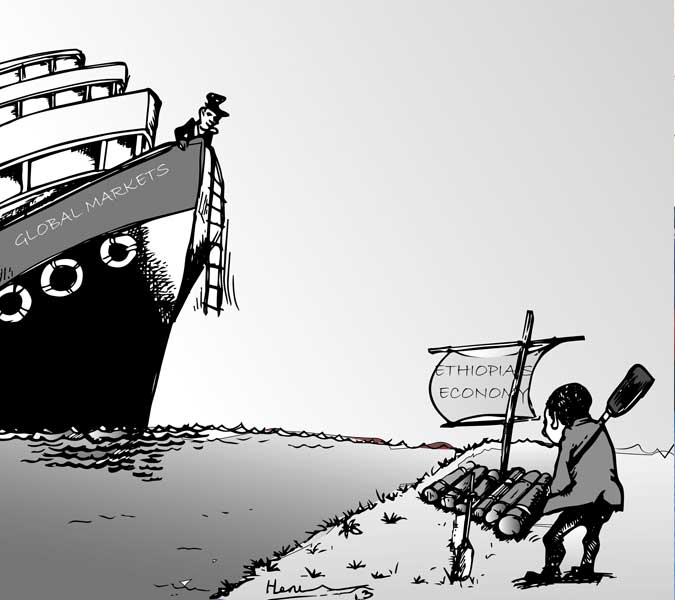
Ethiopia, within this global economy, has to carve a niche for itself. Instead of taking back outsourcing work, the Ethiopian government must provide other local outsourcing services. This has two advantages. First, it creates job opportunities for the young graduates that desperately need them. Second it helps local companies build the experience and discipline that the international market requires. Digitizing has other benefits like building greater domestic efficiencies and minimising corruption. When the Kenyan government decided to automate the banking section of their Ministry of Lands, the revenues jumped from Ksh 800 million to Ksh 9 billion within a six-month period.
Through policy and regulatory frameworks that encourage entrepreneurs, we can increase efficiency, build globally competitive firms and create employment opportunities for our graduates - a win-win situation for all.
PUBLISHED ON
Jul 20,2019 [ VOL
20 , NO
1003]


Viewpoints | Oct 19,2019

Radar | May 28,2022
Commentaries | Feb 13,2021

Fortune News | Jun 21,2025

View From Arada | Jun 04,2022

Photo Gallery | 193830 Views | May 06,2019

Photo Gallery | 183716 Views | Apr 26,2019

Photo Gallery | 180604 Views | Oct 06,2021

My Opinion | 145972 Views | Aug 14,2021







Dec 22 , 2024 . By TIZITA SHEWAFERAW
Charged with transforming colossal state-owned enterprises into modern and competitiv...

Aug 18 , 2024 . By AKSAH ITALO
Although predictable Yonas Zerihun's job in the ride-hailing service is not immune to...

Jul 28 , 2024 . By TIZITA SHEWAFERAW
Unhabitual, perhaps too many, Samuel Gebreyohannes, 38, used to occasionally enjoy a couple of beers at breakfast. However, he recently swit...

Jul 13 , 2024 . By AKSAH ITALO
Investors who rely on tractors, trucks, and field vehicles for commuting, transporting commodities, and f...

Aug 28 , 2026
Every year, the Ministry of Education (MoE) sets a national examination. Every year,...
Aug 22 , 2026
A record is a strange thing to worry about. Federal trade officials have booked the b...

Aug 14 , 2026
Aschalew Fetene, known as “Ardi” and admired for his poetic depth, has built a ti...

Aug 8 , 2026
The World Bank asks readers to picture a mother in rural Ethiopia who has never held...
Aug 29 , 2026 . By BEZAWIT HULUAGER
The federal government is increasingly relying on Treasury bills (T-bills) to repay T...
Aug 29 , 2026 . By NAHOM AYELE
Judges on a Federal High Court bench have ordered D'Afrique, one of Addis Abeba's old...
Aug 29 , 2026 . By BEZAWIT HULUAGER
The Ministry of Revenues wants to know not just who a taxpayer is but almost everythi...
Aug 29 , 2026 . By BEZAWIT HULUAGER
Electricity supplied from Ethiopia has helped halve Djibouti's power production costs...






 Loading your updates...