
Editorial | Mar 07,2026
Please complete the security check to continue.



Oct 21 , 2023
By Shewangezaw Seyoum
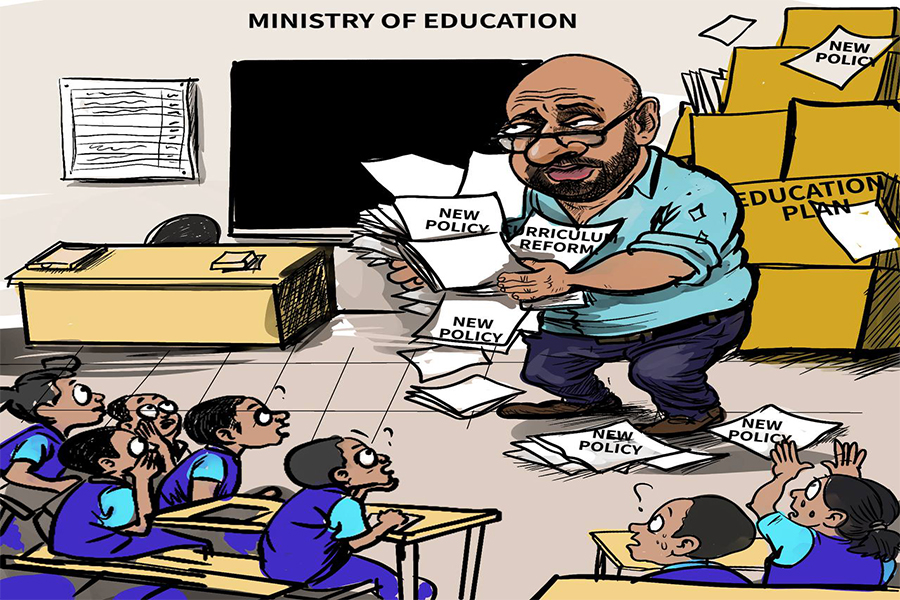
Ethiopia’s long-standing quest for modernisation and socio-economic growth is hitting a stumbling block, one that is casting a long shadow over its future: the education system. The recently released results of the Ethiopian School Leaving Exam, a.k.a matriculations, have brought to light stark deficiencies that require immediate attention.
This year’s matriculation results have sounded alarm bells. From a staggering 845,000 students who appeared for the exam, a mere 3.2pc achieved passing grades, translating to only about 27,267 students. Even more concerning should be that 42.8pc of the 3,106 schools that sat their students for the exams reported zero passes.
There were exceptions, but they were few and far between.
Only five schools celebrated a 100pc pass rate, four being boarding schools scattered across the country. Another five institutions reported pass rates exceeding 94.5pc, dominated once again by boarding schools.
However, this is not an isolated case. Last year, of the 896,520 students who took the same national exam, only 3.3pc surpassed the 50pc mark, leading to a mere half securing university placements.
This decline in matriculation pass rates poses significant challenges for higher education institutions. Over the past few years, Ethiopian universities have undergone expansion to accommodate the youth’s aspirations. However, with dwindling numbers of students meeting university admission standards, these institutions would now struggle with excess capacities.
The Ministry of Education, recognising the widening gap, has reversed its previous decision against remedial exams. This move, although laudable, appears to be a band-aid solution to a more systemic issue.
The remedial measures, while essential, are mere short-term fixes. The focus needs to shift towards addressing the root causes. The Ministry’s officials have expressed their intent, pointing to the ongoing “transformational” reforms in the education sector. The digitalisation of the Ethiopian School Leaving Exam and a push towards greater transparency around results are just a couple of steps in this direction.
However, the spotlight seems disproportionately skewed towards leveraging information technology for student performance measurements. While technology undoubtedly offers solutions, especially in bridging the divide between pre-digital and modern curricula, it should not be viewed as the magic bullet.
A mindset shift, coupled with a cultural evolution, is imperative.
The youth must believe in the value of education and take a proactive role in their learning journey. This evolution calls for an emphasis on fostering intelligence and cognitive skills, over rote learning.
Ethiopia’s tryst with education as a tool for development is not new. The country has historically viewed education as a powerful lever to pull itself out of socio-economic doldrums. From Emperor Haileselassie’s direct involvement in the education sector – he was the Minister of Education at some point - to recent rapid expansions in tertiary education, the state’s belief in the power of education is evident.
Yet, the returns on this investment have been underwhelming. Despite introducing modern formal education over a century ago, Ethiopia remains mired in low-income status, with its economy heavily leaning on foreign aid. Episodes of GDP growth are sporadic, and significant development milestones continue to elude the country.
It is not that education lacks transformative potential.
Globally, several countries have turned the tide of their fortunes through strategic investments in education. The “East Asian Miracle” stands out, with countries like South Korea, Taiwan, and Singapore taking advantage of human capital for meteoric rises. China’s recent ascent, too, is rooted in its robust emphasis on education.
The challenge for Ethiopia lies in its approach. Its leaders' inclination to replicate Western educational models, instead of contextualising and innovating, might be a limiting factor. The focus has been disproportionately on academic disciplines, often sidelining vocational subjects crucial for a balanced workforce.
Success in Ethiopia’s educational paradigm has traditionally been synonymous with academic tenure and credentials. Such a narrow view fails to recognise the importance of real, applicable learning. For genuine socio-economic transformation, the education system needs to prioritise nurturing intelligence.
Emphasising cognitive skills is crucial in today’s rapidly evolving world. These skills, often tested internationally through various intelligence and academic tests, correlate with national wealth, health, and environmental quality measures.
As Ethiopia stands on the cusp of a new academic year, with hundreds of thousands of students set to step into educational institutions, the urgency for change has never been more pressing. The future hinges on the country’s ability to re-imagine its educational strategies, emphasising not just technological advancements, but also fostering the right mindset and cultural shift. The path forward should involve a judicious mix of technology and a reimagined curriculum that aligns with the country's socio-economic aspirations.
The stakes are high, but with intent and a clear strategy, Ethiopia can tap into its latent potential and ensure its youth are equipped for the challenges of the modern world.
PUBLISHED ON
Oct 21,2023 [ VOL
24 , NO
1225]

Editorial | Mar 07,2026
Viewpoints | Jun 21,2025
Commentaries | Jan 03,2021

Editorial | Aug 28,2026
Radar | Jun 11,2024
Featured | Sep 26,2021
Editorial | Jul 08,2023
Fortune News | Nov 21,2020
News Analysis | Jan 05,2020

My Opinion | Oct 18,2025

Photo Gallery | 193883 Views | May 06,2019

Photo Gallery | 183778 Views | Apr 26,2019

Photo Gallery | 180683 Views | Oct 06,2021

My Opinion | 146023 Views | Aug 14,2021








Dec 22 , 2024 . By TIZITA SHEWAFERAW
Charged with transforming colossal state-owned enterprises into modern and competitiv...

Aug 18 , 2024 . By AKSAH ITALO
Although predictable Yonas Zerihun's job in the ride-hailing service is not immune to...

Jul 28 , 2024 . By TIZITA SHEWAFERAW
Unhabitual, perhaps too many, Samuel Gebreyohannes, 38, used to occasionally enjoy a couple of beers at breakfast. However, he recently swit...

Jul 13 , 2024 . By AKSAH ITALO
Investors who rely on tractors, trucks, and field vehicles for commuting, transporting commodities, and f...
Aug 28 , 2026
Every year, the Ministry of Education (MoE) sets a national examination. Every year,...
Aug 22 , 2026
A record is a strange thing to worry about. Federal trade officials have booked the b...

Aug 14 , 2026
Aschalew Fetene, known as “Ardi” and admired for his poetic depth, has built a ti...

Aug 8 , 2026
The World Bank asks readers to picture a mother in rural Ethiopia who has never held...
Aug 29 , 2026 . By BEZAWIT HULUAGER
The federal government is increasingly relying on Treasury bills (T-bills) to repay T...
Aug 29 , 2026 . By NAHOM AYELE
Judges on a Federal High Court bench have ordered D'Afrique, one of Addis Abeba's old...
Sep 1 , 2026 . By BEZAWIT HULUAGER
The Ministry of Revenues wants to know not just who a taxpayer is but almost everythi...
Aug 29 , 2026 . By BEZAWIT HULUAGER
Electricity supplied from Ethiopia has helped halve Djibouti's power production costs...






 Loading your updates...